
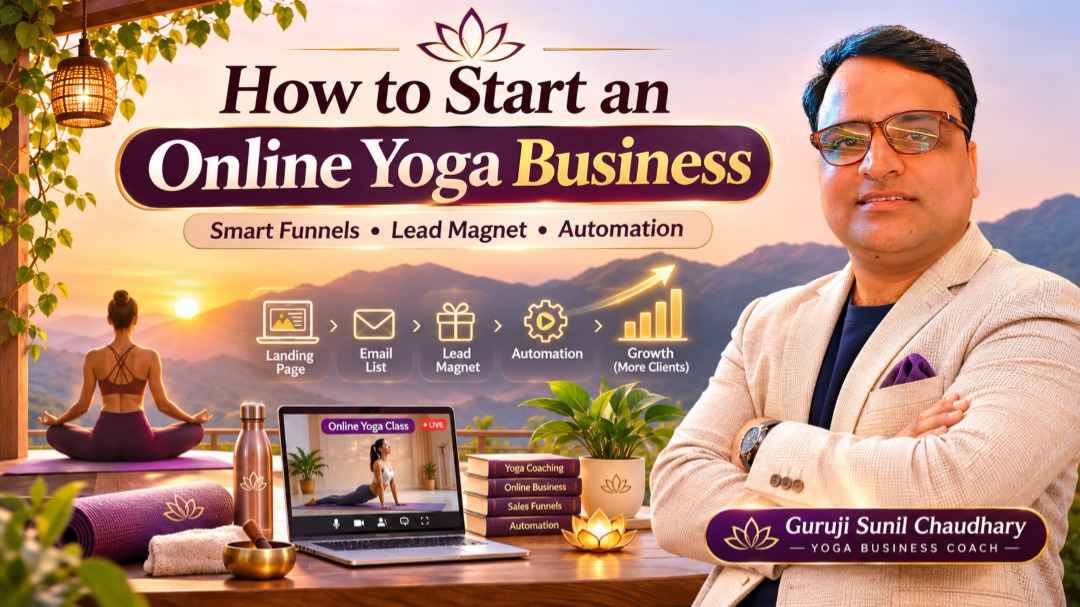
How to Start an Online Yoga Business and Get Students with a Smart Digital Funnel
From choosing your audience and creating a premium “Free Laddu” to building a landing page, automated email nurturing and your first paid Yoga program—learn the complete system without unnecessary tools.
Watch the Complete Online Yoga Business Training
Prefer to learn by listening? Watch this video and follow along with the step-by-step guide below. The training explains the practical business-building framework—from a specific Yoga audience to a simple automated funnel.
If the video does not load in your browser, watch it directly on YouTube.
Yoga Knowledge Is Valuable. But a Yoga Business Needs a System.
You may be a confident Yoga teacher, an experienced practitioner who is preparing to qualify professionally, or a wellness entrepreneur who wants to move from offline classes to online teaching. Yet knowing Yoga and having a sustainable Yoga coaching business are different things. A student needs a safe, meaningful learning experience; a business also needs clear positioning, offers, discovery, registration, follow-up, delivery and retention.
Many new teachers begin by uploading random Reels, sharing inspirational quotes, or announcing “Online Yoga Classes Available.” There is nothing inherently wrong with creating content, but without a defined audience and a next step, attention can disappear without an inquiry. The answer is not to buy ten different tools. It is to design a simple journey that connects valuable information with a relevant paid service.
The approach taught by Guruji Sunil Chaudhary, Sanatani Digital Coach and founder of Career Building School, starts with a question: Whose real problem are you solving? The technology comes later.
Step 1 — Choose Your Exact Online Yoga Audience
“I teach Yoga to everyone” sounds welcoming, but it makes business communication difficult. Different learners need different schedules, experiences and levels of instruction. A beginner working a desk job may want a 20-minute morning routine, while a retired adult may seek gentle, accessible movement in a slower class.
Begin with a niche that aligns with your actual qualifications and knowledge. Possible groups include busy office professionals, absolute beginners, women returning to regular movement, people interested in general relaxation practices, or international learners seeking introductory Yoga classes.
A useful positioning formula is: I help [specific audience] learn [specific safe skill or practice] through [your teaching format].
“I help busy working professionals develop a realistic beginner-friendly morning Yoga routine through live online small-group classes.”
That sentence is more useful than “Best Yoga Teacher for Everyone.” It describes the person, the benefit and the delivery format without promising an unrealistic result.
Step 2 — Discover the Exact Problem Your Students Want Solved
Great marketing begins with listening, not guessing. Ask prospective students what has stopped them from joining Yoga classes. Perhaps they feel intimidated, struggle with consistency, cannot travel to a studio, or do not know which beginner practices are appropriate.
Interview ten people who resemble your target audience. Ask what they have tried before, what they disliked, which times are realistic, and what would make them confident enough to attend a trial session. Their answers can shape your offer and content calendar.
Do not turn a general Yoga coaching program into a medical-treatment promise. Yoga teachers should teach within their training, use appropriate screening and adaptations, and refer medical questions or concerning symptoms to qualified health professionals.
Who?
Working professionals aged approximately 25–45 who are completely new to Yoga.
Problem?
They struggle to make time and feel uncertain about where to begin.
Offer?
A structured beginner program with short live sessions and a weekly tracker.
Proof?
A sample lesson, your credentials, teaching approach and consent-based feedback.
Step 3 — Build One Clear Paid Yoga Coaching Offer
Do not launch five disconnected products at once. Begin with one offer that helps one kind of learner make one kind of progress. For example, a 21-Day Beginner Morning Yoga Program might include three instructor-led sessions per week, a welcome orientation, a practice checklist, basic modifications and a question-and-answer session.
Explain precisely what is included: duration, class times, class size, language, platform, equipment, access to recordings if any, eligibility, cancellations, refunds and support boundaries. A responsible offer also addresses safety and does not guarantee treatment outcomes.
You can test pricing with a limited pilot group. The appropriate amount depends on your experience, location, costs, hours, cohort size and audience—not on an arbitrary high-income promise. Calculate your instructor time, payment fees, marketing expenditure and reasonable profit before setting a rate.
| Offer | Delivery | Who it may suit |
|---|---|---|
| Beginner Group Class | Live sessions on a predictable schedule | Students who prefer community and affordability |
| Private Yoga Coaching | Individual instruction within professional scope | Learners wanting closer teaching attention |
| Foundations Course | Structured recorded lessons with clear safety guidance | Learners requiring flexible timing |
| Corporate Yoga Sessions | Scheduled virtual workplace classes | Teams seeking organized wellness activities |
Step 4 — Create a Premium “Free Laddu” Lead Magnet
Here is the memorable concept from Guruji Sunil Chaudhary’s approach: फ्री का लड्डू—a generous, genuinely useful free resource. In digital marketing, this is called a lead magnet. Its purpose is not to trick people into giving contact details. It helps them solve a small, meaningful problem and lets them experience the quality of your teaching.
For our working-professional niche, build a 7-Day Morning Yoga Starter Guide for Busy Beginners. It can include a short introduction, a simple practice plan suited to your training, safety and modification notes, a daily checklist, a consistency tracker, frequently asked questions and a next-step invitation.
Make it beautiful and practical, but do not mistake design for substance. Every page should help a real person take a useful step. If you provide movement guidance in a PDF, include appropriate safety warnings and encourage personal instruction when needed.
A premium lead magnet outline
- Welcome and whom the guide is designed for.
- What to prepare before beginning—space, clothing and equipment.
- Seven day-by-day beginner practice prompts within your teaching competence.
- Common mistakes and ways to approach practice safely.
- A printable progress tracker with room for reflection.
- An invitation to a free introductory online session.
Step 5 — Automate Delivery with a Landing Page and Thank You Page
Now turn the lead magnet into a simple system. A landing page has one primary job: tell visitors what the free resource provides and make it easy to request it. Do not overload the page with unrelated menus, five offers or intimidating forms.
Use a clear headline, a few benefit bullets, a preview of the guide, a brief introduction about your Yoga qualifications and an accessible registration form. Ask only for information you need. Email is commonly sufficient for a PDF. A phone number should be optional unless genuinely required for the stated service, and promotional messaging needs appropriate consent.
After form submission, send the visitor to a thank-you page. Display a clear download link and, if requested, also deliver the guide via email. Do not force visitors to wait for a promotional sequence to access what you promised.
Simple landing page copy you can adapt
Headline: Get Your Free 7-Day Morning Yoga Starter Guide
Subheading: A beginner-friendly practice planner for busy professionals who want a more consistent morning routine.
Benefits: Seven daily prompts, preparation checklist and printable tracker.
Button: Send Me My Free Guide
Add a clear privacy notice, your contact details and consent options based on applicable law.
Step 6 — Build Trust with Email Nurturing, Not Constant Selling
Someone downloading your guide is not automatically ready to purchase. They may be exploring, comparing instructors, or testing whether your style is a good fit. This is where email nurturing helps. It is a sequence of useful, permission-based communications that introduces your expertise gradually.
| What to send | Purpose | |
|---|---|---|
| Immediately | Guide download and welcome note | Deliver the promise |
| Day 2 | A practical beginner tip | Provide another useful win |
| Day 4 | Your real Yoga teaching story | Build an authentic connection |
| Day 6 | Common beginner questions | Remove uncertainty |
| Day 8 | Invitation to a free demonstration class | Help interested readers experience your teaching |
| Day 10 | Clear program information for interested learners | Offer a relevant next step |
These timings are examples, not universal rules. Monitor replies, unsubscribes and class inquiries, then improve the sequence. Always provide an easy way to opt out of marketing emails and respect messaging preferences.
Step 7 — Use YouTube and Social Media to Earn Trust
A funnel cannot help if no relevant person discovers it. Your job is to publish consistent, useful content aimed at your chosen audience. YouTube is particularly useful for detailed demonstrations and longer educational videos, while Instagram Reels, Facebook and short-form formats can introduce your approach to more people. LinkedIn may work for Yoga programs aimed at working professionals and companies.
Record one useful topic and thoughtfully adapt it to different platforms. A 12-minute YouTube lesson could become a 45-second Reel, a LinkedIn post, a short email, and an article answering an exact search question. The message stays consistent, while the presentation is adapted to each platform’s audience and format.
Content ideas for beginner Yoga teachers
- Three common mistakes when starting a home Yoga routine.
- How to prepare a safe, calm space for an online class.
- What to ask before choosing an online Yoga instructor.
- How a busy professional can make time for regular practice.
- What happens in a beginner-friendly online Yoga class.
- Your own authentic teaching journey and lessons learned.
- A live Q&A answering beginner concerns.
Speak naturally. Show your qualifications and teaching process. Share genuine experiences and, with permission, student feedback. Authenticity is more persuasive than exaggerated transformation promises.
Step 8 — Build a Lean System Before Buying More Tools
It is easy to subscribe to a separate landing-page builder, form platform, email tool, scheduling app, automation service, CRM and course portal before earning your first rupee. Do not confuse the size of the software stack with the strength of the business.
Start by listing what must happen: collect a lead, deliver the guide, send follow-up, book or enroll a student, receive payment and deliver lessons. Choose an integrated solution where it meets your needs; add specialized tools only when there is a clear requirement. Some early-stage businesses can cover much of this with one or two core tools plus a video-meeting service, though the exact number depends on integrations and features.
Factor in subscription costs, payment gateway charges, data protection, export options and ease of use. A tool that saves ten hours but creates expensive lock-in may not be the best long-term choice. Favor a system you can understand and maintain.
Want hands-on implementation help?
The 5 Day Digital Coach Funnel Challenge with Guruji Sunil Chaudhary focuses on practical setup: a lead capture system, landing page and thank-you flow, domain and email integration, automated email follow-up, and a WhatsApp lead journey.
The official course page currently lists a ₹499 offer; check the checkout page for the latest price, access terms and support details.
Step 9 — A Practical 30-Day Online Yoga Business Launch Roadmap
You do not need to master every marketing platform at once. Focus on finishing each stage and learning from real conversations.
Days 1–7: Audience + Offer
Choose your niche, speak with prospective learners, define safe teaching boundaries and outline one pilot program.
Days 8–14: Free Laddu + Pages
Create a premium guide, write a simple landing page, build a thank-you page and test delivery on a phone.
Days 15–21: Follow-Up + Content
Create a short email sequence, publish educational videos, collect permission-based leads and invite people to a free session.
Days 22–30: Pilot + Improve
Run a sample class, listen to questions, invite suitable learners to the paid pilot, and improve the system from real feedback.
These are business setup milestones, not a substitute for professional Yoga teacher training, which may take much longer.
Step 10 — Measure What Matters and Improve Every Month
Do not measure success only by video views. A video with fewer views from the right people may create more appropriate class inquiries than a viral video viewed by an unrelated audience. Keep a simple dashboard of visitor traffic, landing-page conversion rate, lead magnet downloads, email engagement, trial-class registrations, paid enrollments, retention and customer satisfaction.
Use these metrics to diagnose bottlenecks. If content attracts views but no one visits your site, improve the relevance and clarity of the invitation. If people download the guide but never attend a class, review whether the guide and paid offer serve the same audience. If students enroll but leave quickly, focus on teaching experience, scheduling and expectations rather than pushing more marketing.
Consistency matters, but improvement matters too. A reliable system should free up more time for actual teaching and genuine student relationships.
What Makes Guruji Sunil Chaudhary's Approach Different?
Guruji Sunil Chaudhary combines practical digital marketing experience with coaching business systems, SEO, funnels and automation. His central principle is simple: give real value first, build trust through honest communication, and only then offer a relevant program. He calls a well-made free resource the “Free Laddu,” a memorable way to explain lead magnets in approachable language.
The approach prioritizes affordable, manageable systems instead of subscriptions for their own sake. But a good digital funnel is not magic: results depend on teaching quality, audience fit, the clarity of your offer, consistent content and actual execution.
If you prefer independent learning, use this guide and the embedded training to build your first version. If you need implementation guidance, the five-day challenge provides a structured place to begin. For broader digital coaching services, you can discuss your specific needs directly.
Build Your Yoga Coaching Funnel with Practical Support
Stop losing weeks to disconnected tutorials and unclear integrations. Explore a step-by-step system for lead capture, landing pages, email follow-up and WhatsApp journeys. The program is for coaching business infrastructure; it is not Yoga teaching certification.
WhatsApp: +91 9759999231. Program pricing and support conditions should always be confirmed on the official enrollment page.
Frequently Asked Questions About Starting an Online Yoga Business
How can I start an online Yoga business from home?
Develop appropriate Yoga teaching skills, select an audience, create a clear program, set up online delivery and payments, and build a simple website or landing page. Attract prospective students through useful content, referrals and a free guide, then offer a trial or enrollment opportunity.
What is the best way to get students for online Yoga classes?
Understand the learners you want to serve, demonstrate genuine value through content, create a relevant lead magnet, collect permission-based inquiries and invite interested people to a suitable introductory class. There is no single guaranteed platform or strategy.
What is a Yoga coaching lead magnet?
A valuable free resource—such as a seven-day beginner practice planner—that helps prospective students solve a small problem and experience your teaching approach. Guruji Sunil Chaudhary refers to it as a “Free Laddu.”
Do I need expensive software to teach Yoga online?
No. Start with essential functions: registration, communication, lesson delivery, payment and a way to follow up. An integrated platform may reduce unnecessary subscriptions, but compare total costs and capabilities before committing.
How much should I charge for online Yoga classes?
Pricing depends on your qualifications, teaching hours, group size, region, student needs, costs and experience. Test a clearly scoped pilot offer, collect feedback and ensure your rate covers your time and expenses.
Do I need a Yoga teaching qualification?
Suitable professional training is important for safe, credible instruction. Requirements vary by location, teaching context, insurer and type of class. Digital marketing or funnel-training programs do not replace Yoga training.
What is email nurturing for Yoga businesses?
Email nurturing means sending useful, permission-based communications after someone downloads your guide or requests information. The emails build familiarity, answer questions and occasionally invite suitable learners to a class or program.
How does the 5 Day Digital Coach Funnel Challenge help?
The course focuses on business implementation: lead capture, landing pages, thank-you flows, domain and email integration, automated email follow-up, and WhatsApp lead journeys. Check the official course page for current offer details.
Final Thought — Teach with Heart, Market with Clarity, Build with Systems
An excellent online Yoga business is not built by buying more subscriptions or posting random videos indefinitely. It starts with understanding people, teaching responsibly, giving a meaningful free resource, creating a friction-free enrollment path and earning trust through consistency.
Remember the sequence: Audience → Exact Problem → Clear Offer → Free Laddu → Landing Page → Thank You Page → Email Nurturing → Consistent Content → Student Enrollment → Better Student Experience.
Begin with the first step today. When you are ready for structured digital funnel implementation, the 5 Day Digital Coach Funnel Challenge is an available next step.
Jai Sanatan. Vande Mataram.
 Launch your Graphy