There are no items in your cart
Add More
Add More
| Item Details | Price | ||
|---|---|---|---|
Wed Oct 28, 2026
Digital marketing has become an important part of how businesses communicate with customers, promote products, build brands, and generate enquiries. This creates opportunities for people interested in content, search engines, social media, advertising, analytics, and online business growth.
But if you are a fresher, you may have several questions. Which skills should you learn first? Do you need a digital marketing certificate? How can you get hired without experience? What should you put on your resume when you have never worked in a digital marketing role?
These are practical questions, and the answers do not require you to learn every digital marketing tool before applying for a job.
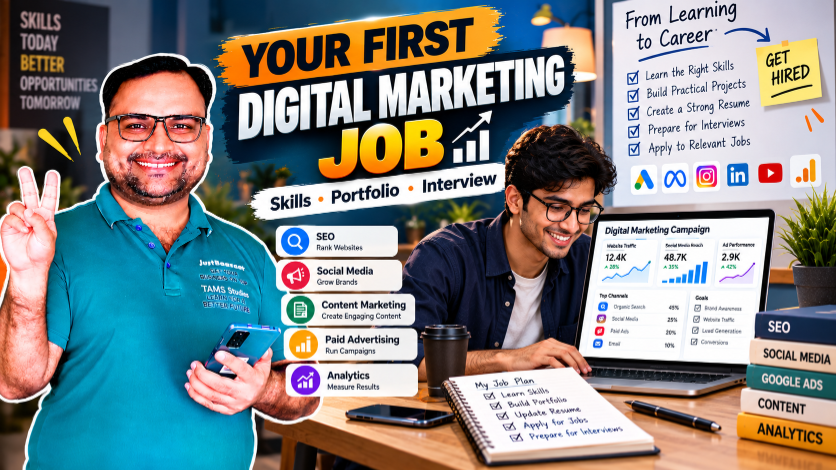
Choose a direction, learn the relevant fundamentals, create practical work samples, prepare a clear resume, and apply consistently to suitable opportunities.
In this guide, I will explain how to approach your first digital marketing job, which skills to prioritize, how to build a portfolio, where to look for opportunities, and how to prepare for interviews.
Digital marketing includes the activities businesses use to reach and engage audiences through online channels. Depending on the organization, a digital marketing team may work on search visibility, social media, email communication, paid advertising, content, website optimization, and performance measurement.
There are different roles within this field, including:
The responsibilities differ from one company to another. A small business may expect one person to support several channels, while a larger organization may have separate teams for SEO, paid media, content, and analytics.
Before applying, read the job description carefully to understand what the employer actually needs.
One common mistake is applying for every digital marketing position without considering whether the requirements match your current skills.
You can improve your preparation by selecting one primary role to target first.
This role may involve keyword research, on-page optimization, content reviews, internal linking, website audits, and monitoring organic search performance.
It can suit people who enjoy research, writing, website structure, and problem-solving.
Responsibilities may include content calendars, captions, creative coordination, scheduling, community engagement, and reporting.
This direction may suit people who enjoy communication, visual content, and understanding online audiences.
This role may involve supporting paid advertising campaigns, checking campaign setup, reviewing metrics, testing creatives, and organizing reports.
It requires attention to detail, analytical thinking, and an understanding of advertising objectives and budgets.
This role may involve researching topics, preparing content briefs, drafting articles, supporting newsletters, and coordinating content publication.
It can suit people who enjoy writing, research, editing, and explaining information clearly.
Choose one primary role and one related alternative. For example, you might target SEO executive positions first and content marketing assistant positions second if your skills support both.
Even if you specialize in one area, understanding the basic digital marketing process will help you see how different activities work together.
Start with these fundamentals:
You do not need advanced expertise in every area. Build a working understanding of the fundamentals, then develop deeper skills in your chosen role.
Tools can help you perform digital marketing tasks, but knowing a tool's name is not the same as knowing how to use it effectively.
Choose tools based on the responsibilities mentioned in the vacancies you want to pursue.
Access to some features or training environments may require an account, a website, or a budget. You can learn many fundamentals through official learning resources and practice exercises without immediately running paid campaigns.
Never claim to have managed live advertising budgets or real customer campaigns if you have only completed tutorials or practice projects.
Learning concepts is important, but employers may also want to understand how you apply them.
You can create practical projects before obtaining your first digital marketing job.
Choose a website you are permitted to review. Examine its page titles, headings, content organization, internal links, and mobile usability. Prepare a report explaining your observations and recommendations.
Choose a hypothetical or consenting business. Prepare a two-week content calendar with post topics, formats, captions, and objectives.
Select a business category and identify relevant search topics. Organize keywords by search intent and explain which pages or content formats might address them.
Create a sample advertising plan that identifies the objective, audience, creative direction, proposed budget assumptions, and metrics you would monitor. Clearly label it as a planning exercise rather than a live campaign.
A small, well-explained project can provide a useful starting point for your portfolio. You can find more guidance in our related Career Building School article on building a career portfolio without work experience. Replace this homepage link with the verified direct article URL before publication.
Your portfolio should help a recruiter or hiring manager understand what you can do.
For an entry-level application, you could include two or three relevant projects, each with a concise explanation of the task and your approach.
For example, an SEO project could include:
For a social media project, you might show the content calendar, a few original creative samples, and the reasoning behind your choices.
Keep your portfolio easy to read. A simple PDF, presentation, or accessible online page can be enough to begin.
Do not invent performance statistics or imply that a sample project was commissioned by a real client. If you use public data, explain its source where appropriate and respect confidentiality and copyright.
Your resume should make it easy for a recruiter to identify your education, relevant skills, practical work, and career direction.
For a fresher, a useful structure is:
Keep the resume concise and tailored to the position.
Entry-level digital marketing candidate with foundational knowledge of SEO, content planning, and social media marketing. Experienced in creating practice projects involving keyword research, content organization, and campaign planning. Interested in applying analytical and communication skills in a digital marketing role while continuing to develop practical expertise.
Customize this example to match your actual abilities and projects. Remove skills you cannot explain or demonstrate.
Use keywords from the job description where they accurately describe your background. Avoid adding unrelated terms simply to make the resume appear more technical.
Courses can help you organize your learning, understand terminology, and practise specific skills.
Depending on your chosen direction, you can explore learning resources from recognized platforms and tool providers. Examples include Google's digital marketing and analytics learning resources, Google Ads training, and Meta's learning materials for advertising and social media.
Before enrolling, check the current course content, prerequisites, cost, assessment requirements, and whether a certificate is included.
A certificate can support your resume, but it does not automatically demonstrate practical competence. Try to pair learning with a project that shows how you apply the concepts.
List a certification as completed only after you have actually completed the relevant requirements.
Search for entry-level roles that match your current preparation. Useful job titles may include:
Use reputable job platforms, company career pages, professional networks, and relevant local opportunities.
When reviewing a vacancy, pay attention to the required experience, daily responsibilities, location, work arrangement, expected skills, and application process.
Do not automatically reject a role because you do not meet every preferred requirement. However, prioritize positions whose essential responsibilities you can reasonably learn or perform.
Research the employer and verify the vacancy through credible channels. Be cautious about job offers that require payment to secure employment or request sensitive information through suspicious channels.
Sending the same resume to every company can make your applications less relevant.
Before applying:
If the role focuses on SEO, emphasize your SEO projects and research skills. If it focuses on social media, showcase relevant content planning and creative work.
Keep your claims honest. Tailoring your resume means emphasizing relevant experience, not inventing experience you do not have.
Interviewers may ask about fundamental concepts, your projects, how you approach problems, and why you want the role.
Prepare to explain the work you have included in your portfolio. Be ready to discuss the objective, your method, your decisions, and what you would improve.
You do not need to memorize long answers. Focus on understanding the concepts and explaining your reasoning clearly.
If you have not worked on a live campaign, say so. You can explain how you would approach the task based on your learning and practice projects.
Digital marketing is not only about tools. You may need to communicate with clients or colleagues, explain your recommendations, organize information, and interpret performance data.
Work on these practical skills:
You do not need perfect English to begin developing these skills. Practise professional writing and speaking regularly, and learn the terminology relevant to your target role.
Strong communication also helps you explain what you know, acknowledge what you do not know, and work effectively with a team.
This plan is a starting framework, not a guarantee of employment within 30 days. Your progress will depend on your starting skills, available time, job market, and the roles you pursue.
Your first digital marketing job may feel difficult to secure, particularly when most vacancies mention experience. But you can take practical steps to become a stronger candidate.
Choose a role, learn the relevant fundamentals, practise with real or clearly identified sample projects, prepare a targeted resume, and apply for suitable vacancies.
Keep improving your communication and analytical skills, and be ready to explain what you have learned through your work.
You do not need to know everything before applying. You need to demonstrate relevant preparation, honest capabilities, and a willingness to keep learning.
Explore Career Building School's learning resources to strengthen your digital knowledge, develop practical skills, and prepare for professional opportunities.
Explore Career Building SchoolYes, entry-level roles and internships may be available to candidates who demonstrate relevant fundamentals, practical skills, and a willingness to learn. Hiring requirements vary by employer.
Choose based on your target role. SEO, social media, content marketing, and paid advertising are possible starting points. Review job descriptions to identify the skills most relevant to the positions you want.
A certificate can support your application, but it does not guarantee employment. Practical projects, communication skills, role-specific knowledge, and interview preparation are also important.
Create clearly labelled practice projects, complete relevant internships where available, participate in suitable volunteer work, or work on projects for consenting clients. Describe your contribution honestly.
Most entry-level digital marketing roles do not require advanced programming, although basic HTML or technical knowledge may help in some SEO, analytics, or website-related positions. Check the requirements of your target role.
Include your education, relevant skills, practical projects, completed certifications, and professional contact information. Tailor the resume to the responsibilities in the job description.
Two or three relevant, well-explained projects can provide a useful starting point. Prioritize quality, clarity, and relevance rather than adding many unfinished examples.
Start with tools relevant to your target role, such as Google Search Console for SEO, content planning tools for social media, or advertising platforms for paid marketing. Focus on practical use rather than tool names alone.
There is no fixed timeline. It depends on your preparation, target role, application quality, employer requirements, and available opportunities.
Yes. An MBA graduate can pursue suitable digital marketing roles by developing relevant practical skills, building a portfolio, and demonstrating how their business knowledge supports marketing work.
Choose your direction, create evidence of your skills, and take the next step toward your first digital marketing role.
 Launch your Graphy