There are no items in your cart
Add More
Add More
| Item Details | Price | ||
|---|---|---|---|
Tue Oct 6, 2026
One of the most common problems I hear from students and freshers is simple:
“I don't have experience, so what can I put in my portfolio?”
This is a very genuine question.
If you have never worked for a company, never handled a paid client, or never completed a formal internship, you may feel that you have nothing worth showing.
But I want you to look at this problem differently.
You may not have professional work experience yet, but you can still create evidence of your ability.
A portfolio does not have to be a collection of projects completed only for paying companies.
A strong beginner portfolio can contain personal projects, practice projects, case studies, research, sample campaigns, website projects, content work, analysis, and other practical demonstrations of your skills.
In this article, I will show you how to build that portfolio step by step.
A career portfolio is a collection of work that helps another person understand what you know, what you can do, how you think, and how you approach problems.
Your resume tells people about your education, skills, and background.
Your portfolio gives them an opportunity to see evidence of those skills.
For example, instead of simply writing:
“I know SEO.”
You can show:
Now the recruiter or client has something concrete to evaluate.
Not every profession requires a portfolio in the same way.
However, for many digital, creative, technology, marketing, communication, and project-oriented roles, a portfolio can be extremely useful.
It can help demonstrate practical thinking when your professional history is still limited.
This is particularly useful for roles such as:
Even when a company does not formally ask for a portfolio, having one can make your professional presentation stronger.
Many beginners think:
“First I need a job. Then I will have projects. Then I will create a portfolio.”
This creates a cycle.
No job → no experience → no projects → no portfolio → difficulty demonstrating experience.
There is another way.
Learn → Build → Document → Showcase → Apply.
You can create projects specifically to demonstrate your skills.
Don't wait for someone to give you permission to create your first project.
If you want to become a digital marketer, start by creating a marketing project. If you want to become an SEO professional, perform an SEO analysis. If you want to become a content writer, create useful content.
There are many possibilities.
A personal project is one of the easiest ways to start.
Suppose you want to work in digital marketing.
You can create a small website or social media page around a topic you understand.
Then document:
You are not pretending that this was client work.
You are showing your ability to plan and execute.
You can also create hypothetical projects.
For example:
“Digital Marketing Strategy for a Local Restaurant.”
You can choose a fictional restaurant and prepare:
Again, be transparent that it is a practice project.
The objective is to demonstrate how you think.
A case study explains a problem, your analysis, your proposed solution, and the expected or observed outcome.
You can create case studies using:
A simple case study structure can be:
This structure demonstrates more than just technical knowledge.
It shows your problem-solving ability.
Let's make this practical.
Suppose your goal is to become a digital marketing professional.
You don't need 50 projects.
You can begin with five strong projects.
Select a website and perform a basic SEO audit.
Look at:
Then prepare a simple report explaining your observations and recommendations.
Select a business and create a 30-day content strategy.
Include:
This demonstrates strategic thinking.
Create a hypothetical campaign for a local business.
For example:
“30-Day Instagram Growth Campaign for a Local Fitness Studio.”
Show the objective, audience, content ideas, posting plan, creative direction, and measurement framework.
Create a simple landing page for a fictional service.
Document:
This project can demonstrate marketing, copywriting, website, and conversion thinking simultaneously.
Choose an existing brand and analyse its digital presence.
Ask:
Present your findings professionally.
If you are still studying, don't wait until your final semester.
Your college itself can become a source of portfolio projects.
For example, you can document:
The important thing is presentation.
Don't simply upload a college assignment and call it a portfolio.
Explain the objective, your role, the approach you used, and what you learned.
This is one of the most powerful techniques I recommend to beginners.
Instead of creating ten shallow projects, take one project and document it deeply.
Project: Personal Website SEO Improvement
Objective: Improve the website's organic visibility.
Research: Identify relevant search terms and content gaps.
Action: Improve page structure, content, titles, internal links, and other relevant elements.
Measurement: Track relevant indicators over time.
Learning: Document what worked, what didn't, and what you would test next.
Now you have a story.
And stories are easier to discuss during interviews than a list of tools.
Try to answer these seven questions:
If you have genuine results, include them.
If you don't have real results, don't invent them.
Instead, explain what you measured or what you would measure.
Never manufacture numbers to make a beginner portfolio look impressive.
Honest documentation of a real learning project is much better than fake claims about traffic, leads, sales, or revenue.
There is no magic number.
Quality is more important than quantity.
A portfolio containing four strong, relevant projects can be more useful than one containing twenty random assignments.
A practical starting point could be:
| Career Direction | Suggested Starting Projects |
|---|---|
| SEO | SEO audit, keyword research, content strategy, technical checklist |
| Social Media | Content calendar, campaign strategy, sample creatives, analytics report |
| Content Writing | Blog articles, landing-page copy, social posts, case study |
| Web Development | Portfolio site, landing page, business website, responsive project |
| Graphic Design | Brand identity, social creatives, advertisements, presentation design |
| Video Editing | Short-form videos, promotional video, YouTube edit, storytelling project |
| Data Analysis | Dashboard, data-cleaning project, analysis report, visualization project |
You don't need an expensive website on day one.
You can begin with a simple online portfolio.
Possible options include:
Choose a platform that makes it easy for a recruiter or potential client to understand your work.
The objective is not to impress people with complicated technology.
The objective is to make your work easy to evaluate.
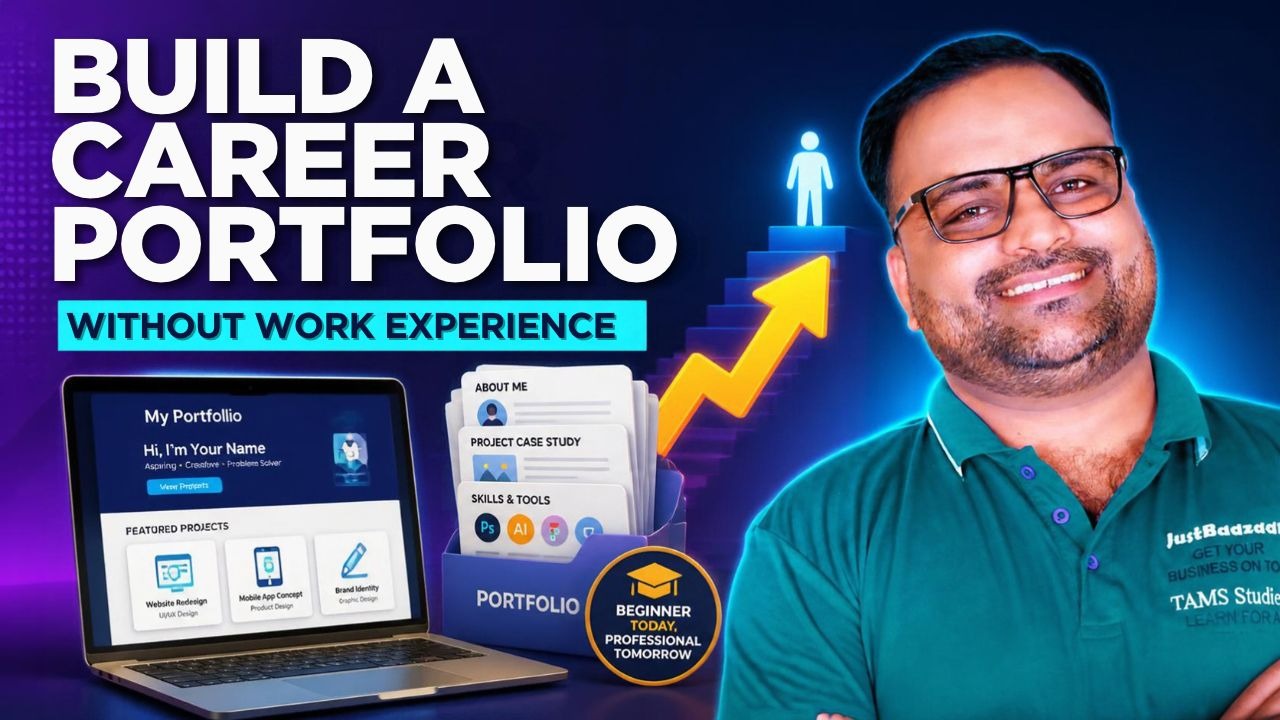
A simple portfolio structure can look like this:
Home
Who you are and what you do.
About
Your education, interests, career direction, and professional focus.
Skills
Your key technical and professional capabilities.
Projects
Your strongest work and case studies.
Resume
A downloadable or viewable professional resume.
Contact
A simple way to reach you.
Keep it simple.
A recruiter should not need to search through ten pages to find your best project.
Don't write:
“Made an SEO project.”
That tells the reader almost nothing.
Instead, write:
“Conducted a structured SEO audit for a sample local-business website, analysed on-page elements and content opportunities, and developed recommendations for improving search visibility and user experience.”
Notice the difference.
The second version communicates your thinking.
Numbers can make a case study clearer, but only when they are genuine.
You can mention:
But don't claim:
“Generated ₹10 lakh revenue”
unless that result actually happened and you can substantiate it.
Professional credibility begins with honesty.
That is okay.
You can create practice projects.
But label them correctly.
Use terms such as:
Don't present a hypothetical project as paid client work.
Recruiters and clients appreciate transparency.
Once you have your projects, improve the presentation.
Use readable fonts, clear headings, consistent spacing, and simple navigation.
Don't hide your strongest project at the bottom.
Use simple language. Avoid filling every project description with technical jargon.
If a project involved multiple people, clearly state what you personally contributed.
Explain why the project mattered and what you were trying to accomplish.
Your portfolio should not exist separately from your professional identity.
When someone visits your LinkedIn profile, your headline, About section, skills, featured projects, and portfolio should tell a consistent story.
For example:
Headline: Aspiring Digital Marketer | SEO | Content Strategy | Social Media
Then your portfolio should contain projects related to those areas.
If your LinkedIn profile says you are an SEO specialist but your portfolio contains only graphic design projects, the positioning becomes unclear.
Consistency builds credibility.
Don't wait for the interviewer to ask:
“Do you have a portfolio?”
If appropriate, mention your project naturally.
For example:
“I haven't worked professionally in this role yet, so I created a few independent projects to develop practical experience. I would be happy to walk you through one of them.”
This answer demonstrates initiative.
Then explain one project using this structure:
You have now turned your lack of formal experience into an opportunity to demonstrate preparation.
| Resume | Portfolio |
|---|---|
| Summarizes your background | Demonstrates your work |
| Usually concise | Can provide deeper project details |
| Lists skills | Provides evidence of skills |
| Focuses on experience and qualifications | Focuses on application and proof |
You don't need to choose one.
A strong resume and a useful portfolio can complement each other.
If you don't have a portfolio today, don't worry.
You can start building one this month.
After 30 days, you may still be a fresher—but you will no longer have to say, “I have nothing to show.”
Don't focus only on technical tools.
A good portfolio can demonstrate several categories of ability.
Can you use the tools required for your chosen role?
Can you identify a problem and develop a logical approach?
Can you explain your decisions clearly?
Can you collect and interpret relevant information?
Can you actually create or implement something?
Can you identify mistakes and explain what you would improve?
These qualities are valuable in many professional environments.
This is another lesson I want beginners to remember.
Your first portfolio will probably not be perfect.
Your first website may not look perfect.
Your first case study may not be perfect.
Your first project may have mistakes.
That is normal.
Your portfolio should improve as your skills improve.
You can update it every few months.
Remove weak projects.
Add stronger projects.
Improve your explanations.
Update your skills.
Show your progress.
One reason practical learning is valuable is that it gives learners opportunities to apply concepts rather than simply consume information.
For example, a structured learning experience can help you move from:
“I know what SEO means.”
to:
“I can perform a basic SEO analysis and explain my recommendations.”
That second statement is much more useful when you are preparing for a job or freelance opportunity.
CBS also has an existing Digital Marketing Internship Program article that discusses practical projects and portfolio development. If you are exploring structured practical learning, you can review that resource here:
Digital Marketing Internship Program
The important point is not simply to collect certificates.
Whatever learning path you choose, try to convert what you learn into visible work.
I want you to change one sentence in your thinking.
Don't say:
“I am a fresher, so I have no experience.”
Instead say:
“I am at the beginning of my professional career, and I have been actively building practical projects to demonstrate my skills.”
There is a big difference.
The second statement does not pretend that you have years of professional experience.
It simply shows that you are taking responsibility for your development.
Your first opportunity may not come because your resume has the longest list of experiences.
Sometimes it comes because someone sees evidence that you are willing to learn, think, create, and take action.
A portfolio can help you communicate that evidence.
You don't need ten years of experience to begin.
You need your first project.
Then your second.
Then your third.
With every project, you become better at your skill and better at explaining your work.
So if you are a student, fresher, career changer, or aspiring freelancer and you currently feel that you have nothing to show, don't wait for experience to magically appear.
Create evidence of your ability.
Learn something.
Build something.
Document it.
Share it.
Improve it.
Then repeat.
If you want to develop practical digital skills that can support your career, freelancing journey, or business goals, explore the learning resources available at Career Building School.
Don't focus only on collecting certificates. Focus on learning, implementing, building projects, and developing the confidence to create value.
Explore Career Building SchoolYes. You can create a portfolio using personal projects, practice projects, academic work, volunteer work, independent case studies, and other genuine examples of your skills.
There is no fixed number. Start with three to five relevant, well-documented projects rather than filling your portfolio with many weak or unrelated projects.
Yes, especially when it demonstrates skills relevant to the role. Explain the objective, your contribution, your approach, and what you learned instead of simply uploading the assignment.
Yes. Hypothetical or practice projects can demonstrate your thinking and execution. Clearly label them as practice, independent, or spec projects and never present them as paid client work.
A website can be useful, but it is not mandatory at the beginning. You can start with an appropriate online platform or professional profile and move to a dedicated website as your portfolio grows.
You can include SEO audits, keyword research, content strategies, social media campaigns, landing pages, marketing analyses, advertising concepts, content samples, and other relevant practical projects.
Certificates can support your profile, but they should not replace evidence of practical ability. Whenever possible, combine learning credentials with projects that demonstrate how you applied the knowledge.
A portfolio can help you demonstrate practical ability and give interviewers something concrete to discuss. It cannot guarantee a job, but it can strengthen your professional presentation when the projects are relevant and honestly presented.
Review it periodically. As your skills improve, replace weaker projects with stronger ones, update outdated information, and add new work that better represents your current capabilities.
Your experience starts somewhere. Let your first project be the beginning.
 Launch your Graphy