There are no items in your cart
Add More
Add More
| Item Details | Price | ||
|---|---|---|---|
Thu Oct 15, 2026
You enter the interview room, greet the interviewer, and take your seat. After a few introductory words, the interviewer looks at you and asks:
“Tell me about yourself.”
It sounds like a simple question. After all, you know yourself better than anyone else. Yet many candidates struggle to answer it professionally.
Some begin describing their entire childhood. Others repeat everything written on their resume. Some speak for five minutes without explaining why they are suitable for the job. And others become so nervous that they forget what they wanted to say.
If you have experienced any of these situations, you can improve with preparation and practice.
It is to give the interviewer a clear, relevant picture of your background, your capabilities, and why you are interested in the opportunity.
In this guide, I will explain how to structure your answer, what to include, what to avoid, and how to introduce yourself in simple English. You will also find practical examples for freshers, MBA candidates, digital marketing applicants, finance candidates, and experienced professionals.
This question often appears at the beginning of an interview because it gives the interviewer an opportunity to understand your professional background and start the conversation.
Your answer may help them understand:
The interviewer is not necessarily expecting a perfect speech. They want an introduction that makes sense for the role and gives them useful information to explore through follow-up questions.
Think of your answer as a short professional summary that you speak rather than write.
For many entry-level interviews, around 45–90 seconds is a useful starting point. Some interviews may require a shorter introduction or invite a longer explanation.
The right length depends on the question, the role, and the interviewer's expectations.
Your introduction should be long enough to communicate the essentials but short enough to leave room for conversation.
A practical rule is this: include only the information that helps the interviewer understand your suitability for the job.
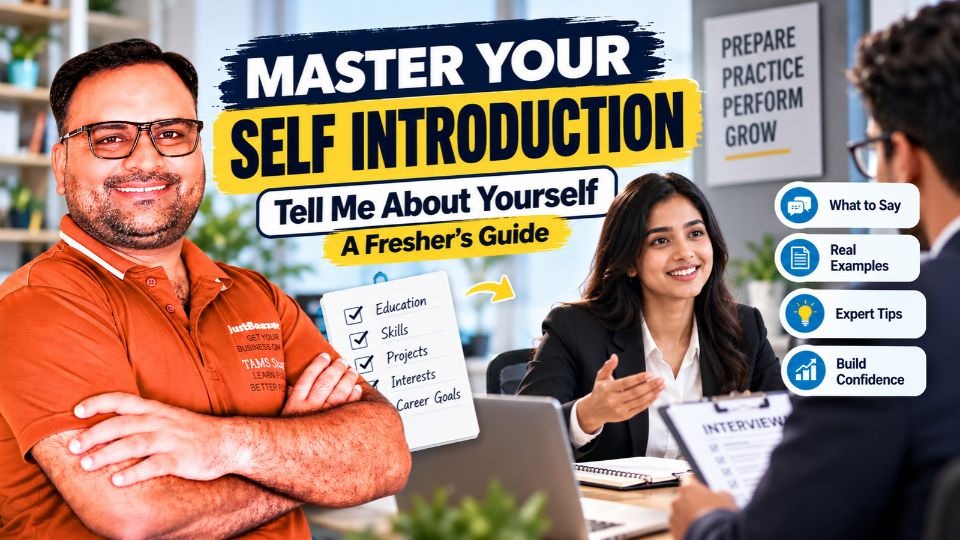
You can organize your answer into five simple parts.
Begin politely and state your name if appropriate. Then briefly mention your qualification or current educational status.
For example:
“Good morning. My name is [Your Name]. I have completed my bachelor's degree in [Your Subject] from [Institution Name].”
If you are still studying, explain that accurately. If your final result is pending, do not describe the qualification as completed when it is not.
Choose two or three skills that relate to the job.
For example, a digital marketing candidate may mention SEO, content planning, and social media marketing. A finance candidate may discuss Excel, financial fundamentals, and analytical thinking.
Do not list every skill you have ever studied. Prioritize the ones you can explain or demonstrate.
If you have completed a relevant project, briefly explain what you worked on and what you learned.
If you have no professional experience, you can discuss an academic assignment, personal project, or structured learning activity.
Be clear about the nature of the work. Do not present a practice project as a paid client assignment.
Tell the interviewer what interests you about the field or type of work.
For example:
“I am particularly interested in digital marketing because I enjoy understanding how businesses reach their audiences through online platforms.”
Make the explanation genuine and relevant to the position.
Finish by explaining why you are interested in the opportunity and what you hope to contribute or learn.
For example:
“I am looking for an opportunity where I can apply these skills, learn from an experienced team, and develop my professional capabilities.”
This provides a natural ending without sounding overly dramatic.
This example is suitable as a starting point for a candidate applying for an entry-level role. Personalize it before using it.
Sample answer
“Good morning, and thank you for giving me this opportunity. My name is [Your Name], and I have completed my [Qualification] from [Institution Name]. During my studies, I developed an interest in [Relevant Field] and worked on improving my skills in [Skill One] and [Skill Two]. I have also worked on [Project or Learning Activity], which helped me understand some practical aspects of the subject. I am now looking for an entry-level opportunity where I can apply my knowledge, learn from the team, and contribute responsibly to the organization's work.”
This introduction works as a framework because it covers education, relevant skills, practical learning, and career direction.
Do not recite it mechanically. Replace the placeholders with accurate information and use words you can speak comfortably.
An MBA candidate can connect their management education to the responsibilities of the role.
For a marketing position, you might emphasize customer understanding, communication, and marketing projects. For a finance position, you might focus on financial fundamentals, analysis, and spreadsheet skills.
Sample answer
“Good morning. My name is [Your Name], and I have completed my MBA from [Institution Name]. During my management studies, I developed an interest in [Marketing/Finance/Human Resources/Operations]. I have been working on strengthening my understanding of business concepts and developing practical skills relevant to this field. Through [Relevant Project or Activity], I learned how to approach tasks in a more structured way. I am now looking for an opportunity where I can apply my management knowledge, gain practical experience, and continue growing as a professional.”
Choose the specialization that matches your actual education and the job you are pursuing. If you have not completed your MBA, state your current status accurately.
Digital marketing interviews may explore your understanding of online channels, content, search engines, campaigns, and performance measurement.
Your introduction should highlight the areas most relevant to the vacancy.
Sample answer
“Good morning. My name is [Your Name], and I am building my career in digital marketing. My main areas of interest are SEO, content strategy, and social media marketing. I have been developing my skills through practical learning and projects, including [Relevant Project]. These activities have helped me understand how keyword research, useful content, and audience targeting can support digital marketing objectives. I am interested in this position because I want to apply my knowledge in a professional environment, learn from experienced marketers, and contribute to the team's work.”
If the job is focused on paid advertising, analytics, or another specialization, adapt your introduction to those requirements instead.
For a finance-related position, focus on relevant financial knowledge, analytical ability, attention to detail, and familiarity with required tools.
Sample answer
“Good morning. My name is [Your Name], and I have completed my [Qualification] in [Subject]. I am interested in building my career in finance and business operations. I have been developing my understanding of financial concepts, spreadsheet analysis, and business reporting. Through my academic work and practice activities, I have learned the importance of accuracy, organized information, and careful analysis. I am looking for an entry-level opportunity where I can apply these fundamentals, gain practical experience, and continue learning from the team.”
Only mention specific tools or technical skills when you have enough knowledge to discuss them if the interviewer asks follow-up questions.
Sales interviews may focus on communication, customer needs, relationship-building, and the ability to handle challenges.
Sample answer
“Hello, my name is [Your Name], and I have completed my [Qualification]. I am interested in sales and business development because I enjoy understanding people's needs and communicating solutions clearly. During my studies and other activities, I have been developing my communication, problem-solving, and organizational skills. I understand that sales requires patience, follow-up, product knowledge, and a willingness to learn from feedback. I am interested in this opportunity because I want to develop these abilities in a professional environment and contribute to the team's objectives.”
Use an example from a genuine project, internship, or relevant experience if you have one.
If you have work experience, you do not need to spend most of your introduction explaining your education.
Focus on your current or most recent role, relevant responsibilities, professional strengths, and interest in the new position.
Sample answer
“Good morning. My name is [Your Name], and I have experience in [Industry or Function]. In my current or previous role, I have worked on [Relevant Responsibilities]. This has helped me develop skills in [Relevant Skills] and understand the importance of [Relevant Business Priority]. I am now exploring opportunities where I can use this experience, take on new responsibilities, and continue developing professionally. This position interests me because it aligns with my experience and the direction in which I want to grow.”
Add a genuine achievement if it helps demonstrate your suitability. Make sure any figures or outcomes you mention are accurate and that your contribution is clear.
A good introduction is not only about what you include. It is also about what you leave out.
The interviewer has asked for a professional introduction, not your complete personal history.
Keep the focus on your education, skills, experience, interests, and suitability for the role.
Your resume is already available to the interviewer in many cases. Use the introduction to highlight the most relevant points rather than reading every line aloud.
Avoid statements such as “I am the best candidate” unless you can support a specific claim appropriately.
It is better to demonstrate your strengths through relevant examples.
You do not need to begin by explaining that you lack experience or asking the interviewer to overlook your background.
Instead, present your current qualifications, relevant skills, and willingness to learn.
Long, difficult sentences can make it harder to speak naturally.
Use simple language that you understand and can communicate clearly.
Information about your family, hobbies, or personal life may be relevant if the interviewer asks about it or it helps explain something important. It does not need to dominate your opening introduction.
You do not need sophisticated English vocabulary to deliver a clear self-introduction.
Start with short sentences and familiar words.
For example, instead of saying:
“I aspire to leverage my multidisciplinary competencies to facilitate organizational excellence.”
You could say:
“I want to use my skills to contribute to the team and continue learning.”
The second version is easier to understand and speak naturally.
If you are nervous, practise the introduction in three stages:
Record yourself if possible. Listen for unclear sentences, repeated words, and places where you speak too quickly.
Improvement comes from repeated practice, not from criticizing yourself for every mistake.
Memorizing every word can make you nervous if you forget one sentence.
Instead, remember five keywords:
Practise explaining these points in your own words.
Try delivering the introduction three different ways while keeping the same main information. This helps you become more flexible when the interviewer changes the wording of a question.
Your introduction may lead to additional questions. This is normal and can help the interviewer understand your background in greater detail.
If you mention an academic project, be ready to explain its purpose and your contribution.
If you mention a skill, be ready to describe how you have used it or what you understand about it.
If you mention a career interest, be prepared to explain why that field appeals to you.
For example, after you mention SEO, an interviewer might ask what keyword research means or how you would approach improving a website page.
Do not include details in your introduction merely because they sound impressive. Include information you can discuss honestly.
Prepare a short introduction using your actual education, skills, projects, and career interests.
Replace long or difficult sentences with clear language you can speak comfortably.
Deliver your introduction several times without reading it word for word. Focus on the main points.
Prepare to explain the skills, projects, and experiences you mention.
Ask a friend to listen to your introduction and give feedback on clarity, relevance, pace, and confidence.
Repeat the exercise until your answer feels natural rather than rehearsed.
Your introduction is a conversation starter, not a performance that must be delivered perfectly. Clear thinking, relevant information, and honest communication are more useful than memorizing a speech.
“Tell me about yourself” is a common interview question, but you do not need a complicated answer.
Introduce your background, mention relevant skills, share a project or experience if you have one, explain your professional interest, and connect your answer to the role.
Keep it concise. Practise speaking aloud. Use words you understand. Be prepared to explain anything you mention.
If you are a fresher, remember that you are not expected to describe years of professional experience you do not have. Your task is to communicate your current capabilities honestly and show that you are prepared to learn.
A clear self-introduction will not guarantee selection, but it can help you begin the interview with a more organized and professional answer.
Explore Career Building School's learning resources to develop practical skills, strengthen your professional knowledge, and prepare for future career opportunities.
Explore Career Building SchoolStart with your education, mention relevant skills, briefly discuss a project or learning experience, and explain your interest in the role. Keep the answer concise and accurate.
Around 45–90 seconds is a useful starting point for many entry-level interviews. Follow the interviewer's cues and adjust the length to the question.
Usually, you should prioritize your professional background, skills, and career interests. Mention personal details only when they are relevant or requested.
Use short sentences, familiar vocabulary, and a clear structure. Practise your introduction aloud and focus on communicating your ideas rather than using complicated words.
An MBA fresher can mention their qualification or current study status, relevant specialization, practical projects, skills related to the job, and the type of opportunity they are pursuing.
Learn the structure and main points rather than memorizing every word. This helps you speak naturally and adapt your answer to the conversation.
Focus on your education, relevant skills, academic learning, and genuine career interests. You can also develop a small practice project before the interview if it is relevant and you have enough time.
Summarize your current or recent role, relevant responsibilities, key skills, and interest in the new position. Choose the experience most relevant to the vacancy.
Not usually. Focus on relevant strengths and experience unless the interviewer specifically asks about weaknesses or an area you are improving.
Prepare your main points, practise aloud, review your resume, and rehearse likely follow-up questions. Confidence can improve as you become more familiar with your own introduction.
Prepare your story, practise your words, and begin your next interview with clarity.
 Launch your Graphy