
Impact Made by Guruji Sunil Chaudhary — Sanatani Digital Coach
From a farmer’s son earning ₹1,000 a month in 2004 to a multi-platform digital educator connecting learners across 100 countries and territories.
An extraordinary journey is best understood through the work it leaves behind. This editorial brings together the personal history, educational platforms, dated performance analytics, learner geography, professional articles, and original video testimonials associated with Guruji Sunil Chaudhary.
The beginning was humble. The mission became global. The work is still unfolding.
A Life That Refused to Be Defined by Its Beginning
In 2004, the story looked nothing like a global digital education story. It looked like a young man doing physically demanding work around a truck, earning ₹1,000 in a month, and trying to understand what kind of future might be possible. The young man was Sunil Chaudhary, born into a farming family in the Aligarh region of Bharat. Financial difficulty was not a passing metaphor in his early life; it was part of the environment in which choices were made, ambitions were tested, and perseverance developed.
Move forward more than two decades and a different picture emerges. Guruji Sunil Chaudhary is now associated with multiple learning and business platforms, including Career Building School, Digital Coach Bharat, and JustBaazaar. His work connects education, search visibility, digital entrepreneurship, mentoring, personal development, content, and practical implementation. Courses and learning experiences extend through dedicated websites, Udemy, Systeme.io, and paid YouTube memberships.
What makes this journey worth documenting is not a single title or a promotional slogan. It is the accumulated trail of work: platforms established, lessons published, learners reached, relationships sustained, training videos created, students supported, and technology used to bridge geography. An educator who began in a village is now connected to learners across continents. The contrast is striking, but the connecting thread is more interesting: a continuing decision to teach, to adapt, and to build.
This editorial follows that thread. It brings together published biographical material, platform analytics dated November 2026, learner geography, an instructor dashboard, an extensive collection of testimonial videos, and public articles that show the evolution of an educational philosophy. It also looks at something subtler than numbers: why someone seeking digital independence may need more than a collection of recorded lectures.
There is a human story here, but there is also an operational story. The human story concerns struggle, dignity, reinvention, and purpose. The operational story concerns courses, websites, search traffic, learning systems, coaching frameworks, paid communities, and global distribution. Both matter. One explains why the work began; the other shows how it reached beyond its place of origin.
For Sunil Chaudhary, the core identity remains straightforward: a proud Bharatiya, a Sanatani, and a Digital Coach committed to helping people convert knowledge into meaningful action. The journey from a ₹1,000 wage to a multinational learning footprint is not presented here as an overnight miracle. It is the outcome of years of education, business decisions, hard losses, rebuilding, and sustained digital effort.
The Farmer’s Son and the Education of Responsibility
The earliest classroom in a person's life is not always a school. Sometimes it is a farm, a family facing an uncertain season, or a household in which every rupee has to be considered. Sunil Chaudhary grew up in a farming family near Aligarh, in the village of Mangarhi in the Gonda block. That origin has continued to inform the way he speaks about effort, responsibility, and opportunity. His personal account on Digital Coach Bharat explicitly connects his rural roots with patience, work, and the belief that beginnings do not have to determine destinations.
Farming develops a particular relationship with time. Sowing does not guarantee a harvest the following morning. Attention must be repeated; conditions can change; losses remain possible despite sincere effort. Those lessons have an evident parallel in education and enterprise. A content creator can publish hundreds of pieces before building trust. A coach may spend months refining a curriculum. A learner may need repeated attempts before mastering a tool. What looks sudden to an outsider often has years of hidden preparation behind it.
In the biography of a modern digital educator, it is tempting to start with followers, traffic, or course sales. That approach misses the formative material. The more consequential beginning is an environment in which self-reliance was necessary rather than fashionable. A farmer's household may have few of the advantages often associated with emerging technology businesses, yet it can cultivate endurance and close attention to practical outcomes.
His story also challenges the assumption that sophisticated digital work belongs only to particular metros or privileged educational institutions. It is possible to master online systems while retaining a deep connection to a village, a family, a language, and a cultural identity. Digital distribution can remove some geographic boundaries without requiring a person to erase where they come from.
That distinction is especially relevant to the audience he serves. Many aspiring coaches are teachers, professionals, consultants, small business owners, homemakers, or people who have been told their knowledge is too ordinary to become a serious educational offering. An educator who understands constrained beginnings can speak credibly about starting with limited resources. He does not have to pretend that the limitations are imaginary.
To understand the later growth of Career Building School and Digital Coach Bharat, first understand this: the mission was shaped by proximity to ordinary people and ordinary pressures. The subject of the work is digital opportunity, but the motivation is human possibility.
2004 — The ₹1,000 Month and the Meaning of Work
One of the most unforgettable images in the Sunil Chaudhary story is a young worker cleaning a truck in 2004. The monthly earning was ₹1,000. It is a small number by the standards of digital business conversations, but it is an important number precisely because it brings the narrative down to earth. Before the courses, before the mentoring programs, before the international learners, there was work that demanded time and physical effort for modest pay.
The significance of this episode is not that one kind of work is inferior to another. There is dignity in honest labor. The significance is the distance between circumstances and eventual possibilities. At that stage, the immediate question may be how to earn, how to contribute, and how to keep going. The later question becomes how to build a system that creates value for others in many locations simultaneously. The journey crosses not merely an income divide but a change in the nature of work.
Many stories of entrepreneurship erase the uncomfortable early chapters. They begin at the launch announcement, the first successful sale, the photograph on a stage, or the polished website. Those images can inspire but also mislead by hiding the years that precede them. The ₹1,000 chapter serves as a useful correction. It reminds readers that an educator's present work can be shaped by experiences far removed from a camera, laptop, or conference hall.
It also gives meaning to his emphasis on implementation. A person who has experienced the cost of wasted time and uncertain income may be particularly sensitive to vague advice. In the coaching environment, that sensitivity can become insistence on usable steps: choosing a niche, building a page, developing content, publishing consistently, finding an audience, and understanding what a customer needs.
There is no need to turn this beginning into a fairy tale. Financial hardship does not automatically produce success; many hardworking people face obstacles that perseverance alone cannot solve. Yet the trajectory here demonstrates that an early occupation need not permanently determine a person's professional identity. Skills can be learned, relationships built, and an existing path redirected.
The central lesson is not “everyone will become famous.” It is more responsible and more useful: the person doing modest work today may still possess the ability to build something meaningful tomorrow. That message gives the opening chapter its emotional force without reducing the story to sentimentality.
From Work to Teaching — The Foundation of an Educator
Sunil Chaudhary's public biography dates his broader professional journey to 2006, a year associated with the beginnings of his education-related work and TAMS Studies. His later material describes a major coaching transition in March 2014. These milestones matter because they show that the current digital identity did not appear fully formed. Teaching, business operations, learner support, and customer communication developed across stages.
Education is both an intellectual and an organizational activity. Someone can know a subject well and still struggle to teach it. A sustainable coaching institution must create repeatable ways for learners to understand, practice, ask questions, and progress. It must also deal with enquiries, marketing, course design, staffing, technology, and follow-up. Those are not incidental concerns; they shape whether knowledge reaches the people who need it.
The progression from local teaching to online education therefore reflects a shift in distribution as much as a shift in curriculum. A classroom has physical boundaries. An online platform can accommodate a learner thousands of kilometers away, but only if the educator also learns content delivery, digital trust, onboarding, payments, recorded learning, community support, and technical maintenance.
His published writing on the Freedom Business Model connects the appeal of knowledge-based entrepreneurship with greater control over time and location. A separate 2022 article describes his decision to use the designation Digital Success Coach, reflecting an emphasis on the learner's outcome rather than merely the technical subject taught.
This evolution suggests a guiding question: what is an education program really selling? A stack of videos? A certificate? A hopeful identity? Or the ability to perform an action independently? A practical coach has to keep moving toward the last answer. The learner should eventually be able to make decisions, understand tools, and build work that did not exist before the learning experience.
The teaching foundation is thus not simply a date in a biography. It helps explain the later combination of digital marketing, mentorship, practical systems, and mindset development. The technology changed repeatedly. The underlying role—helping another person learn and advance—remained recognizable.
JustBaazaar — Learning Digital Business in the Real World
The emergence of JustBaazaar in 2016 marked an important extension from instruction into applied digital business. Search engine optimization, online visibility, lead generation, local discovery, content publishing, and promotional strategy are not abstract classroom topics for an operating business. They create daily questions: how does a customer find a company? Why does one page rank and another disappear? What makes a visitor trust a service? How do content and commerce connect?
Digital marketing becomes most useful when it is treated as a chain of connected decisions rather than a bag of tricks. A website must communicate clearly. A useful article should meet a genuine search need. A lead magnet should offer substance. A follow-up system should respect the potential customer's time. Analytics should reveal the difference between attention and action. JustBaazaar gave Sunil a commercial context in which these ideas could be implemented and refined.
This business experience also forms a bridge between coaching and service delivery. Some learners want to acquire the skill themselves. Others need implementation support because their business must keep running while new systems are built. The distinction creates opportunities for different forms of mentoring, from training to collaborative execution to done-for-you services.
Search optimization is a particularly instructive example. Publishing a page is not the same as making it useful. Rankings are not the same as revenue. A visible website still needs compelling positioning and a workable path from first visit to meaningful enquiry. These connections become easier to teach when the educator has worked with actual businesses instead of relying only on diagrams.
In earlier published articles, Sunil described a long engagement with SEO and digital marketing and explained how an online-first model could support business freedom. Those archived writings are part of the documentary trail of his professional development. They demonstrate continuity in subjects that remain central to his current platforms: content, discoverability, marketing systems, and entrepreneurship.
For readers evaluating an educator, this applied dimension is relevant. They may ask not only whether the teacher understands terminology but whether they can connect the technology to real decisions. JustBaazaar represents that practical side of the story: knowledge tested through implementation, and implementation converted back into education.
The ₹98 Lakh Setback and the Discipline of Rebuilding
Successful public profiles often compress adversity into a phrase such as “overcame challenges.” That language is too tidy for major financial loss. In his published biography, Sunil Chaudhary describes a difficult phase in 2019 involving a loss approaching ₹98 lakh. He writes about the impact on identity, confidence, and the direction of his work. Soon afterward, the COVID period brought fresh uncertainty to educators and businesses everywhere.
The significance of a setback of that scale is not merely monetary. It can alter the relationships among risk, trust, debt, responsibility, planning, and ambition. An entrepreneur may be forced to reconsider assumptions that seemed obvious during growth. An educator may discover that a large facility and a large team do not by themselves guarantee resilience. A mentor may become more cautious about promises that sound simple in marketing but carry real consequences for the learner.
His biographical account also describes a period of employment and a subsequent shift toward digital service work and coaching during the disruption. It is a reminder that professional identity is rarely linear. A person can move from entrepreneurship to employment and back again without the deeper mission disappearing. Recovery can involve ordinary work, revised plans, and deliberate decisions rather than a dramatic single turning point.
There is a connection between this history and the structure of his current teaching. A freedom-oriented business cannot be measured solely by an impressive monthly revenue screenshot. It also needs stability, a clear offer, manageable costs, a predictable client journey, and repeatable processes. These are less glamorous than motivational slogans, but they can be the difference between a fragile project and a durable enterprise.
For an aspiring Digital Coach, stories of loss may be more valuable than polished success narratives. They introduce necessary questions: how much should be invested before there is proof of demand? What happens when a campaign fails? Is a business dependent on one platform? Can customer relationships be maintained if a particular algorithm changes? What is the plan for setbacks?
The purpose of examining difficulty is not to glorify suffering. It is to show that the teacher's guidance was shaped by difficult decisions and consequences. Resilience is not the absence of failure; it is the capacity to examine what failed and build again with greater care.
Digital Coach Bharat — Turning Experience into Opportunity
Digital Coach Bharat articulates a simple proposition: people who possess real knowledge, skills, experience, or life lessons may be able to teach those things through digital platforms. This is especially meaningful in a society where many capable individuals do not recognize their own knowledge as something valuable to others.
The platform addresses teachers and trainers, working professionals, consultants, homemakers, subject experts, wellness guides, entrepreneurs, and people seeking a purposeful next chapter. It makes an important distinction between being famous and being useful. A person does not necessarily need an enormous audience to begin. They need a clear area of value, an understanding of whom they can help, and a reliable way to demonstrate that value.
Sunil's official introduction on the platform emphasizes clarity, courage, consistency, and direction. He describes digital coaching as a process of helping people move from hidden knowledge to visible authority, from confusion to structure, and from random activity to purposeful business systems. This framework connects personal transformation with operational steps rather than presenting them as competing priorities.
In practice, the path usually begins with identifying a suitable coaching topic. Then comes a carefully defined audience, an honest promise of learning, accessible content, an online identity, communication channels, and an offer that matches the audience's real needs. Later stages may include landing pages, courses, webinars, payment tools, email sequences, communities, analytics, and paid promotion. Each step creates decisions that benefit from informed guidance.
There are risks in any digital business model, and thoughtful mentoring should make room for them. Not every topic has equal demand. Not every audience is ready to pay. A recorded course is not automatically a business. A paid advertisement cannot rescue an unclear offer. The program's value, therefore, must be judged by how well it helps a learner understand the realities of building and serving an audience.
Digital Coach Bharat represents a recognizable modern form of Bharatiya entrepreneurship: rooted in local experience, enabled by global technology, and directed toward helping more people participate in the knowledge economy. The name signals place and identity; the underlying opportunity is not constrained by national borders.
Career Building School — An Educational Ecosystem, Not a Single Course
Career Building School is a central pillar of the ecosystem. Its website presents a curriculum covering digital coaching, SEO, AI, automation, YouTube, social media, content strategy, email nurturing, personal branding, and the skills needed to operate a knowledge-based business. It describes an implementation-oriented learning approach rather than simply access to information.
The distinction matters because skills rarely function in isolation. Someone may learn to edit a video but remain unsure what the video should communicate. Someone may build a landing page but have no relevant offer. Someone may understand SEO but fail to convert visitors into trusting customers. An integrated curriculum makes those connections explicit and lets learners understand where each tool fits in a larger system.
On the public school website, the language repeatedly returns to the sequence “Learn. Implement. Build. Grow.” This is more than a slogan when applied carefully. Learning develops knowledge; implementation tests knowledge; building creates an asset or process; growth comes from observing results and improving. Without the middle steps, education risks becoming a collection of notes and unused subscriptions.
The Digital Success Membership offers an example of the broader model, describing access to courses, live classes, and implementation support across multiple digital subjects. The public catalog and articles provide further pathways for people with different goals and starting points.
Career Building School also anchors the most extensive geography data supplied for this report. Its country-level learner distribution covers 100 country and territory entries, while a separate website analytics snapshot provides traffic and engagement metrics across a multi-year period. These two datasets should be read together but not confused: learner geography speaks to where learners are based; website analytics speaks to how visitors use the platform.
The institution illustrates what digital education can become when a founder moves beyond a single recorded course. It becomes a system of content, learning experiences, community, support, and continuing interaction. A learner might enter through a free article, take an introductory course, attend a live session, join a membership, and eventually build a real project. The quality of that journey depends on the continuity of the experience.
A Learning Footprint Across 100 Countries and Territories
The international dimension of this story is visible in Career Building School's supplied learner geography. The country-level report lists 100 distinct countries and territories. Its locations span South Asia, North America, Latin America, Western and Eastern Europe, Africa, Southeast Asia, the Middle East, and Oceania. That distribution changes the scale of the discussion: this is not only a local educator sharing ideas online, but a learning platform connecting with people in many parts of the world.
The largest entries in the provided dataset include Bharat, the United States, China, Brazil, Singapore, and Viet Nam. Other listed locations include the United Kingdom, Bangladesh, Pakistan, Mexico, Ukraine, the United Arab Emirates, Argentina, South Africa, Colombia, Canada, Australia, France, Germany, the Russian Federation, Iraq, the Netherlands, Spain, Indonesia, Nigeria, Romania, Malaysia, Morocco, Kenya, Hong Kong, Saudi Arabia, and many more.
Some locations contain large numbers; others contain single-digit counts. This variation is normal in cross-border digital learning. A new learner may find a course through search, a recommendation, a social post, a video, or an international professional network. The important fact is the geographic breadth of the learning community. A class or lesson created in Bharat can be discovered by someone living on another continent and operating in a different professional and cultural setting.
The country labels supplied by the dashboard include territories as well as sovereign states. For that reason, the most precise headline is “100 countries and territories,” a phrasing that is both strong and faithful to the source list. Combining this list with the separate Udemy report and other platforms may extend the overall geographic footprint; a complete deduplicated union would require matching all location lists rather than adding counts mechanically.
International presence creates opportunity and responsibility. Learners may have different time zones, levels of English comprehension, internet access, business regulations, and market conditions. Good educational material must distinguish principles that travel well from details that need local adaptation. A search strategy may be global in concept but depend on local language and intent. A payment platform may be available in one place and restricted in another.
The global footprint therefore demonstrates more than reach. It raises a larger question: how can a culturally rooted educator design learning that is accessible to people whose circumstances differ? Digital distribution provides the bridge. Clarity, empathy, useful examples, and adaptable frameworks determine whether people can cross it.
Udemy — An Independent Learning Distribution Channel
Alongside his own educational properties, Sunil Chaudhary maintains an Udemy instructor profile. This offers another way for learners to encounter his courses beyond a branded website. A marketplace can introduce an educator to students who are searching for a skill rather than a particular personality, expanding the possibilities for discovery.
An Udemy instructor performance export dated 21 November 2026 shows 225 students across 29 countries in the selected instructor dashboard view. The five largest visible country entries are Bharat (130 students), the United States (44), the United Kingdom (6), Canada (5), and Italy (5). Its language report shows seven learner language categories, with English the largest in the displayed snapshot.
These metrics have value because they come from the operational context of an instructor dashboard rather than an abstract description of “global success.” They identify an actual learning distribution channel, a date, an overall student count, and recorded locations. They also illustrate why a multi-platform profile should not be reduced to one marketplace. Udemy is one part of an educational ecosystem that also includes Career Building School, Systeme.io-based courses, and paid YouTube learning opportunities.
There is an important operational lesson here for digital educators. Relying on a single platform can simplify the early journey, but it can also make an educator dependent on that platform's visibility, pricing, discovery rules, or payment policies. A diversified approach allows students to find content in several places and gives an educator more ways to communicate, teach, and support.
Different platforms also serve different types of learning. A marketplace course may be an ideal entry point for self-paced study. A membership may create continuity. A live coaching call may solve a specific implementation problem. A recorded YouTube lesson may introduce a topic to a wide audience. A dedicated mentoring program may connect all of these elements to a personal project.
Seen in context, Udemy provides both evidence of international teaching and an example of deliberate educational distribution. The achievement is not simply publishing a course on another website. It is making instruction available to learners who might never have visited the original institution.
The Numbers Behind the Website — 42,000 Visitors and 191,900 Page Views
A separate screenshot from the Graphy-hosted Career Building School environment provides a website usage snapshot for 30 June 2023 through 21 November 2026. It records approximately 42,000 unique visitors, 191,900 page views, and 50,400 sessions. The same interface displays an average session duration of 5 minutes 46 seconds and a 47% bounce rate.
These figures describe platform visibility and interaction. They do not automatically count course completions, income generated, or the number of successful businesses built. Used correctly, however, they tell an important part of the educational story: people have repeatedly found and used the digital property over an extended period. Sustained online learning requires that kind of discoverability before deeper learning experiences can even begin.
Page views also tell a different story from unique visitors. One individual may explore several articles, course pages, landing pages, or other sections in a visit. Sessions capture periods of interaction, while average session duration offers a broad measure of time spent in those sessions. None of these metrics should be treated as interchangeable with the 100-location learner geography list.
The dashboard displays a monthly bar chart with changing levels of traffic across the observed years. Some periods are noticeably stronger than others. That pattern reflects a reality familiar to educators and content creators: demand fluctuates; content gains and loses visibility; campaigns create surges; audiences respond differently over time. Consistency is rarely a straight upward line.
For a platform founder, the practical challenge is to convert attention into learning without compromising trust. A visitor who discovers a valuable answer may return for a related lesson. A well-structured learning page can lead that person toward a course. A helpful course can introduce a deeper mentoring option. Each stage requires clarity rather than aggressive pressure.
The analytics also connect to an earlier part of Sunil's professional story: the emphasis on SEO and organic visibility. Creating educational material is one task. Helping that material become discoverable, relevant, and useful is another. His business and educational work sit at the intersection of those disciplines.
When the editorial refers to these statistics, it uses the screenshot's dated reporting window. The snapshot is a concrete piece of historical evidence, not a promise of any particular future traffic or student outcome.
Why Implementation Support Is Different from Information
Digital education has a persistent problem: the gap between understanding an explanation and completing the work. A learner may watch a lesson about search optimization and still struggle to choose a page topic. A business owner may understand the purpose of a sales funnel but never connect a form, email sequence, and payment page. An aspiring coach may spend months creating content without developing a coherent offer.
Sunil Chaudhary's professional positioning places unusual emphasis on this gap. His public websites describe handholding, practical guidance, business systems, personal branding, audience building, and implementation-oriented mentoring. The underlying promise is not that a teacher can do every task for every student. It is that education becomes more useful when the learner can see how concepts are put into practice.
Consider the difference between two learning experiences. In the first, a student is told what a landing page is. In the second, the student identifies an audience, chooses one problem, drafts the copy, builds the page, connects a form, checks mobile usability, and learns how to measure conversions. Both involve knowledge. Only the second builds a functioning asset and the capacity to repeat the process.
The same principle applies to YouTube growth, email nurturing, client acquisition, SEO, automation, and paid campaigns. A mentor can reduce confusion by showing the order in which decisions are made. The learner still has to perform the work, assess the results, and make adjustments. Good coaching should increase independence rather than create permanent dependency.
Implementation support can also differ by program. Some people need structured group learning. Others require one-to-one guidance. A business at a later stage may need assistance integrating several technologies or refining an existing system. The public Career Building School membership describes learning accompanied by support, while the broader ecosystem includes more specialized pathways.
There is no ethical shortcut that guarantees a profitable business to everyone. Outcomes depend on existing skills, effort, audience needs, execution, capital, competition, and external conditions. A serious educator works within those realities. The real value of mentoring is improved clarity and informed action, not the invention of certainty.
This is why the word “support” deserves a prominent place in the editorial. It describes a relationship that continues beyond publication of a video and places attention on what happens when a learner tries to use the knowledge.
SEO, Content and Discoverability — The Skills Behind the Mission
Search engine optimization is one of the most enduring threads in Sunil Chaudhary's professional material. While platforms and interfaces change, the central challenge remains: how does a person make genuinely useful information discoverable when someone is actively looking for it? A search query is often a statement of need. A successful piece of educational content begins by respecting that need.
SEO involves understanding search intent, creating technically accessible pages, writing helpful content, organizing information, building clear navigation, and observing performance. It also requires patience. Search visibility often develops through consistent work rather than a single dramatic action. For an educator teaching entrepreneurship, SEO is especially valuable because it connects expertise to the questions people already ask.
But discoverability now extends well beyond traditional search pages. Audiences find information through short videos, social communities, professional networks, YouTube search, newsletters, direct recommendations, and AI-assisted discovery tools. An educational business benefits when it describes its work clearly, publishes substantial original materials, and maintains consistent identity across those destinations.
Career Building School's public catalog includes SEO, AI, automation, personal branding, YouTube, content, and email nurturing. These subjects can be treated as separate technical courses, but they are more useful when presented as parts of an interconnected experience. Search attracts attention; clear content builds understanding; a useful offer earns consideration; a good onboarding process helps the learner begin; support encourages continued progress.
For aspiring coaches, this integrated view is essential. A sophisticated AI tool cannot replace a clear mission. A beautifully designed website cannot compensate for a program that fails to help students. A viral video may bring visitors who are not the right audience. Skills become powerful when they are attached to a real problem and a responsible solution.
Sunil's archived content on starting an online coaching business and digital coaching blueprints provides additional context for that broader educational focus. In the long arc of this story, SEO is both a subject taught and a practical instrument of educational reach.
Systems, Automation and Sustainable Digital Entrepreneurship
A modern online coaching operation is built from many small systems. Someone must be able to discover the educator, understand the offer, receive relevant guidance, enroll securely, access lessons, ask questions, and continue learning. Behind that visible journey sit forms, email systems, payment providers, course platforms, scheduling arrangements, content management, support messages, and analytics.
Automation can reduce repetitive work, but it cannot substitute for an ethical relationship with students. A welcome email can deliver the right instructions at the right moment. A reminder can help someone return to a lesson. A segmented message can direct beginners and experienced professionals toward different resources. But sending more automated messages is not, by itself, evidence of better learning.
In Sunil's coaching ecosystem, the value of systems is presented in connection with freedom, consistency, and business growth. A well-designed system should make service easier to deliver and easier to receive. It should leave more time for important human work: teaching difficult concepts, reviewing decisions, correcting misunderstandings, and supporting meaningful projects.
There is also a resilience advantage in understanding the system rather than depending entirely on a vendor or contractor. A coach who knows where leads originate, how emails are triggered, and where students need support can make better decisions. Even when implementation work is delegated, technical literacy reduces confusion and protects the continuity of the learning experience.
Digital entrepreneurship is often marketed as effortless income, but sustainable systems are created through planning and maintenance. Software subscriptions must be evaluated. Content needs updating. Tools change their interfaces. Privacy expectations matter. Regulations differ by market. A genuine business must account for these responsibilities without losing sight of the student's experience.
That balance—automation where it helps, human attention where it matters—connects technical coaching with the broader values of service and responsibility. It is also one reason that the same educator can operate across course platforms, memberships, articles, and social channels without treating every digital interaction as a transaction.
YouTube, Public Education and Paid Member Learning
YouTube plays two roles in the wider Sunil Chaudhary ecosystem. First, it functions as a public educational channel through which ideas, explanations, demonstrations, commentary, and coaching insights can reach viewers who are not enrolled in a dedicated program. Second, paid YouTube memberships and course-oriented material offer additional opportunities for committed learners to access structured content and continuing support.
That distinction matters because the educational relationship does not always begin with a purchase. A person may discover a helpful explanation, watch several videos, understand the speaker's teaching style, and only later decide whether deeper learning makes sense. Public content can lower the cost of exploration for someone who is unsure what subject or path to follow.
For a teacher, video creates a distinctive type of connection. Viewers can hear the speaker's explanations, notice the pace of instruction, and observe whether complicated ideas are made practical. Live sessions allow questions to surface, revealing what learners actually find confusing. Recorded videos preserve explanations so people can return at a convenient time.
Paid memberships add a different element: continuity. A learning relationship may benefit from regular sessions, curated resources, accountability, and a dedicated environment where members know what to expect. The exact content and benefits depend on the particular membership arrangement, but the broader educational principle is familiar: sustained learning often requires more than a one-time introduction.
The 16 testimonial videos supplied for this editorial are also hosted through YouTube URLs. They create a public-facing collection of learner and participant voices that readers can watch directly rather than relying only on edited excerpts. This is particularly useful in an editorial about educational impact: the reader can move from written context to the original videos and form an impression based on the material itself.
Not every view becomes a student, and not every member will have an identical outcome. The value of the YouTube component lies in accessibility, format diversity, and the ability to connect instruction with people outside the boundaries of a formal classroom. For a Bharatiya educator speaking to a global audience, that distribution power is an important part of the story.
A Sanatani Worldview in a Modern Digital Economy
Guruji Sunil Chaudhary's professional identity includes a deliberate cultural and philosophical commitment. He identifies as Bharatiya and Sanatani, and he brings that rootedness into discussions of mindset, entrepreneurship, responsibility, and personal growth. This need not be understood as a rejection of modern technology. In his positioning, heritage and innovation are meant to coexist.
One useful bridge is the principle of thoughtful action. The Bhagavad Gita's emphasis on performing one's duty with discipline and without obsessive attachment to immediate results has enduring relevance to difficult long-term work. Digital educators and entrepreneurs benefit from consistent effort, sound decisions, integrity in teaching, and a realistic view of outcomes. Growth requires action, but action should be guided by purpose.
Another bridge is the importance of learning. In a world where software tools change rapidly, the willingness to remain a student is essential. Learning can be understood not merely as acquiring another certificate but as refining judgment and becoming more capable of helping others. A mentor who remains teachable models an important form of intellectual humility.
Service is also central. A business can create revenue while respecting its responsibility to customers. A coach can pursue success without using fear or humiliation as a marketing technique. A community can celebrate cultural roots while welcoming learners from other countries and backgrounds. Values become meaningful when they shape practical choices, not when they appear only in a slogan.
This editorial does not require readers to share Sunil's beliefs to understand his educational work. International learners arrive with different cultures and convictions. The relevant professional question is how a teacher's guiding philosophy influences the consistency, care, and intention with which education is delivered. Cultural identity and openness to the world are not contradictory.
His writing on Sanatani approaches to personal development adds context to this part of his work. It demonstrates that the platform's subjects extend beyond a narrow collection of software tutorials. The ambition is to connect digital capability with an inner framework of responsibility, self-development, and meaningful contribution.
Mindset Without Magical Thinking — The Power of Thoughtful Action
Digital entrepreneurship can attract people at vulnerable moments: after a disappointing job experience, during a financial transition, or while trying to build something alongside family responsibilities. Motivation can help someone begin, but motivation alone is insufficient. That is why the combination of mindset and implementation deserves scrutiny.
A practical mindset approach does not promise that wanting something makes it happen. It asks the learner to clarify a goal, identify the relevant skills, develop a routine, measure progress, and change methods when evidence suggests a better path. Confidence matters, but informed confidence matters more. Optimism becomes useful when it produces responsible action.
The title of Sunil Chaudhary's book, Power of Thoughtful Action, captures the central theme. Thinking without doing can become avoidance. Doing without thinking can become expensive confusion. Thoughtful action brings reflection and execution together. In education, that may mean selecting a manageable project rather than consuming another ten hours of introductory videos.
This philosophy also helps explain why a mentor's lived experience can matter. Someone who has encountered substantial business setbacks can approach risk with greater seriousness than a person whose advice consists only of success slogans. The ability to acknowledge complexity can make guidance more useful, especially for students who have limited resources or depend on their businesses for household stability.
A learner may need encouragement to publish a first video. Another may need the opposite advice: to stop expanding, review the numbers, refine the offer, and listen more carefully to customers. Meaningful coaching is not a constant demand to move faster. It is helping people choose better actions for their particular circumstances.
In the broader editorial arc, mindset is therefore not decorative inspiration. It is a framework that connects identity, discipline, uncertainty, and practical work. The most durable message is simple: be ambitious, remain grounded, learn carefully, and take the next useful step.
Student Voices — Why Testimonials Belong in the Evidence Record
Analytics reveal reach, and websites reveal offerings, but neither fully communicates the lived experience of learning. That is where student and participant videos become important. A testimonial is a person's account of an interaction, experience, or perceived benefit. It can show what mattered to that individual, which aspects of support were memorable, and how they describe the learning relationship in their own words.
The editorial includes 16 YouTube videos directly supplied as testimonial references. Rather than converting them into invented quotations or condensed promises, the videos appear below as playable embeds with links to their original YouTube pages. This allows readers to encounter the material firsthand. Some are standard videos and two are Shorts. Their individual titles and speakers should be read from the videos themselves rather than guessed from an unfamiliar URL.
A collection like this illustrates another aspect of educational impact: people are willing to spend time describing their interactions with a mentor or program. The content of each testimony may differ. Some people may emphasize technical learning. Others may highlight encouragement, personal guidance, a change in confidence, or a specific business project. Those distinctions are part of the texture of a real learning community.
Testimonials are most persuasive when presented with respect for the speaker. No participant should be made to endorse an outcome they did not describe. A personal story should not become a promise of identical results for a new student. When readers have access to the original material, they can examine tone, context, and detail for themselves.
The result is a more human form of documentation. Numbers establish a scale of participation; videos allow individual experiences to be heard within that larger scale. Together, they present a richer picture than either could provide alone.
16 Video Testimonials and Participant Experiences
Each player below opens the original YouTube-hosted testimonial reference. Watch the speakers in their own words, in the original context.
One Ecosystem, Many Kinds of Learners
One of the challenges of modern digital education is that students arrive with widely different needs. A college learner may want an employable skill. A working professional may want a second income channel. A teacher may wish to turn years of subject experience into online lessons. A local business owner may need a website that attracts relevant enquiries. An established consultant may be ready to build a structured coaching offer.
These people should not be treated as identical customers. Their starting knowledge, available time, financial position, professional responsibilities, and goals differ. A program that works well for a beginner might frustrate a specialist. A highly technical workshop may overwhelm someone who has never used a course builder. Differentiated guidance is therefore a sign of educational maturity.
The subjects offered across the Sunil Chaudhary ecosystem reflect this diversity. SEO and search strategy speak to visibility. Content creation and YouTube speak to communication. Automation and email systems speak to delivery and continuity. Personal branding speaks to trust. Coaching business development connects expertise with offers, pricing, enrollment, and student service.
Crucially, a learner can enter from several directions. Someone who begins with a free SEO article may discover a coaching workshop. Another may first encounter a YouTube explanation and join a paid membership. A business owner may begin with service requirements and later decide to learn the system independently. The platform mix creates pathways that did not exist in a single-room teaching model.
There is a broader access story here. Cross-border digital learning means that geographical distance no longer automatically prevents participation. It does not eliminate language, cost, connectivity, or time-zone barriers, but it changes what is possible. A learner in a smaller town can study the same digital principles as someone in a large commercial centre.
The larger mission is not to produce copies of the educator. It is to help different people build capabilities suited to their own lives. A successful coaching ecosystem should enable students to develop their own voices, offer genuine value, and make decisions based on their circumstances.
What Real Educational Impact Looks Like Beyond the Dashboard
“Impact” is a powerful word, but it becomes meaningful only when connected to observable activities and results. In the context of an educational platform, there are several layers worth distinguishing. The first is access: people can find resources and begin learning. The second is engagement: people spend time with the material, attend sessions, or continue participating. The third is capability: learners understand and can apply a useful skill. The fourth is transformation: that capability contributes to a meaningful change in work, confidence, opportunity, or service.
The sources in this editorial illuminate these layers differently. The geographic learner list and Udemy dashboard document international distribution. The website analytics reveal recorded traffic and interaction. The public school and program pages describe the learning opportunities and support model. The testimonial gallery provides firsthand video material from participants. None of these sources needs to pretend to do the job of the others.
For example, 191,900 website page views are not equivalent to 191,900 completed courses. A visitor in a new country does not automatically represent a profitable coaching business. A sincere testimonial about feeling supported is valuable as a human account, even when it does not contain a revenue figure. Keeping those meanings clear makes the educational story stronger rather than smaller.
Future impact documentation could add case studies organized around a defined starting point, learning intervention, completed project, and subsequent result. A learner who built a first website, a consultant who launched a structured program, or a business owner who improved lead handling could tell a specific and instructive story. With consent, supporting screenshots or project links would turn those stories into useful examples for other learners.
That is the standard toward which a serious educational brand can grow: not just visibility, but an increasingly clear record of capability developed and work completed. The current report provides a substantial foundation by combining multiple forms of documentation already available in November 2026.
The story of Sunil Chaudhary is therefore both a personal journey and an evolving record of educational work. It can be expanded as more learners share projects, more platform exports become available, and the ecosystem continues to develop.
Serving Coaches, Creators, Consultants and Small Businesses
The modern knowledge economy is not limited to full-time educators. It includes professionals who want to share specialist experience, creators building trusted audiences, consultants seeking repeatable service models, and business owners attempting to communicate their value online. These groups overlap, but each has its own barriers.
A coach may understand a subject but struggle with offers and lead generation. A creator may have audience attention without a sustainable business model. A consultant may deliver excellent work but depend entirely on referrals. A local entrepreneur may know customers personally but be almost invisible online. Practical digital education can help each group close a different gap.
Sunil Chaudhary's positioning as a Digital Coach Business Mentor includes the language of clarity, personal support, systems, content, leads, and implementation. This is a useful combination because business growth involves the interaction of several disciplines. A person has to be discoverable, credible, competent, reachable, and able to fulfil the expectations created by their marketing.
At the same time, different businesses have different definitions of success. One person may want a modest additional revenue stream while preserving family time. Another may aim to establish a full-time educational enterprise. A third may simply need to improve customer experience. A responsible mentor does not impose one ideal lifestyle on everyone. The better question is whether the system serves the learner's actual priorities.
The Freedom Business Model essay helps explain Sunil's own preference for flexible, knowledge-based work. In today's economy, that model still requires economic realism: recurring responsibilities, customer acquisition, consistent delivery, and investment in skills. Freedom comes from designing an operation that can be sustained, not from ignoring the work required to sustain it.
This broader audience makes the ecosystem a platform for practical career and business development rather than a single-topic course library. It also explains why its impact can extend into diverse professions and locations while remaining centered on a common educational approach: knowledge becomes valuable when it helps somebody do something meaningful.
Teaching Across Borders While Remaining Proudly Bharatiya
Global educational reach raises questions of identity. Must an educator become culturally neutral to teach across borders? Must a program abandon the language and values of its origins to be relevant internationally? Sunil Chaudhary's stated position offers another answer: one can remain proudly Bharatiya and Sanatani while working with learners from many different backgrounds.
That is a powerful aspect of today's digital environment. A professional identity that begins in the Aligarh region can be encountered in North America, Europe, Africa, Latin America, the Gulf, and Asia. The basic technologies of online learning—video, websites, asynchronous courses, digital payments, written resources, communities—allow expertise to travel. Their effectiveness still depends on translation between contexts.
For example, an aspiring coach in one region may face different advertising costs from a peer elsewhere. Cultural expectations around personal branding can vary. Some audiences prefer extensive written information while others respond to live demonstration. Payment methods and compliance requirements differ. The more international a learning platform becomes, the more important it is to teach principles without confusing them with one universal local method.
There is a related responsibility in language. Clear English can make a program accessible internationally, while Hindi and other Bharatiya languages can make knowledge feel closer to home for domestic audiences. A multi-language educator need not choose between these audiences. Different formats can serve different needs while retaining a consistent educational mission.
The supplied learner geography places this discussion on a practical footing. A hundred country-and-territory entries are not merely a decorative map. They represent a wide range of cultural contexts within which educational content is being encountered. That breadth offers opportunities for feedback, revision, and learning from the audience itself.
In this sense, the global reach is a two-way street. The educator shares skills across borders, and the variety of learners can reveal new examples, new problems, and better ways of teaching. Local roots provide an anchor; international contact provides perspective.
The Evolution from Classroom to Digital Platform Network
Looking across the milestones, a broad progression becomes visible. Early work and responsibilities gave way to education and local coaching. Business operations and digital marketing expanded the practical toolkit. Major setbacks required rebuilding and reevaluation. Dedicated digital learning platforms, course marketplaces, and video channels then multiplied the ways in which learners could find and engage with his teaching.
This is not simply a migration from offline to online. It is a change in the architecture of education. A local classroom concentrates the learning relationship into a specific place and schedule. An online course makes instruction asynchronous. A live community brings back dialogue. An SEO article can introduce a person who has never heard the teacher's name. A paid membership makes continuity possible. A one-to-one session can address a specific challenge that a general course cannot anticipate.
Each layer answers a different need. When assembled thoughtfully, they can support a learning journey with several entry points and levels of depth. The challenge is to keep the ecosystem coherent so that a learner understands where to begin, what comes next, and which programs are appropriate for their goals.
The growth of such an ecosystem also requires the founder to become an organizer of knowledge. Courses must be structured, support expectations defined, technology selected, materials maintained, and audience feedback translated into changes. Good educational operations are not produced by a camera and a charismatic presenter alone.
The public record shows several pieces of this evolution: the 2022 Digital Success Coach essay, ongoing Career Building School course offerings, the Digital Coach Bharat biography, and historical writing at JustBaazaar. They reveal a long-running focus on teaching, digital business, and professional identity.
The striking result is that one educational mission can now exist in several formats at once. The learner does not need to live near the original institution to benefit from it. Geography has become a consideration rather than an absolute boundary.
Trust, Transparency and the Responsibilities of a Mentor
Impact should be accompanied by responsibility. An educator who attracts students across many markets must pay attention not only to teaching quality but also to how offers are presented, how support is described, and how expectations are formed. Trust is especially important in digital business education because learners may invest money, time, and emotional energy in the hope of changing their professional direction.
A responsible learning environment makes clear what the student will study, what support is included, which resources are needed, and how progress can be assessed. It avoids turning illustrative case studies into promises. It encourages testing and learning rather than dependence on exaggerated forecasts. Those standards are compatible with confident, ambitious coaching; in fact, they make the ambition more credible.
This is also why original-source links matter in a long-form editorial. Readers should be able to visit the institutions, view the courses, watch testimonial videos, inspect published background articles, and understand the meaning of key statistics. The aim is not to bury the audience under technical disclaimers. The aim is to make the record clear enough that readers can follow it.
Sunil's own public teaching emphasizes practical work, knowledge-sharing, mentoring, and ongoing development. For an experienced Digital Coach, that creates an obligation to keep learning as tools change. AI systems, search platforms, course software, payment technologies, and social video formats continually evolve. A mentor's relevance depends partly on the willingness to revise yesterday's advice when today's environment requires a different method.
The responsibility extends to cultural identity as well. A Sanatani framework can be expressed through discipline, service, ethical action, and respect for others. International learners need not share every philosophical commitment to benefit from instruction in SEO, content, digital systems, or business development. Professional generosity is strongest when it is confident in its roots and open in its teaching.
Trust is ultimately built through the repeated alignment of words and actions. A compelling story invites attention; the educational experience must justify that attention over time. That is the standard by which meaningful mentorship is measured.
What This Journey Means for the Next Generation
The most durable feature of an educator's work is not a single course launch or one successful marketing campaign. It is the possibility that knowledge can continue to produce useful action long after the original lesson was created. A student who becomes able to teach, build, communicate, or run a project may carry those skills into work that the original teacher never directly sees.
For young people and working adults from financially constrained backgrounds, the beginning of Sunil Chaudhary's story matters for a reason. It offers an alternative to a narrow definition of professional possibility. Starting in humble conditions does not guarantee future success, but it does not make meaningful growth impossible. Learning can compound. Experience can become expertise. Expertise can become service. Service can become an institution.
The global nature of the current ecosystem also changes the meaning of local achievement. Building a learning initiative in the Aligarh region once implied an audience limited by travel and proximity. Today, structured educational resources can be discovered in countries far removed from the founder's starting point. That shift opens new possibilities for Bharatiya educators who have something practical to teach.
A meaningful legacy would also include the independence of learners. The ideal outcome of coaching is not that every student remains permanently dependent on the founder. It is that learners become confident enough to make sound decisions, serve their own audiences, and perhaps teach others responsibly. Educational influence becomes deeper when knowledge spreads through capable people.
The scale of that influence is still unfolding. The current platforms provide a foundation of content, systems, recorded learning, memberships, and support pathways. Additional case studies, updated learner statistics, and new educational programs can extend the record. A living institution is never finished; it should continue testing, improving, and serving.
The same is true of personal identity. Guruji Sunil Chaudhary's present work reflects a combination that might have seemed unlikely in 2004: farmer-family roots, early manual work, local education, SEO, business-building, Sanatani philosophy, and international digital teaching. Its distinctiveness lies in how those experiences have been carried forward rather than left behind.
The Real Measure of a Journey
Consider the two scenes again. The first is a young worker in 2004, earning ₹1,000 a month and navigating financial hardship. The second is an educator whose learning ecosystem includes Career Building School, Digital Coach Bharat, JustBaazaar, Udemy courses, Systeme.io-based learning, YouTube content, and paid memberships. A supplied Career Building School country report names 100 countries and territories. A dated Udemy instructor export records 225 students in 29 countries. A separate website analytics screenshot records approximately 42,000 unique visitors and 191,900 page views over its selected reporting period. Sixteen original testimonial videos provide further human context.
These are different kinds of evidence, and each illuminates a different part of the work. Together, they document the breadth of the educational undertaking more clearly than a single slogan could. They show a platform network, international distribution, ongoing publishing, and learner participation across multiple formats.
Yet the numbers are not the whole conclusion. The deeper narrative concerns the conversion of experience into service. Hardship became an understanding of practical constraints. Teaching became a professional vocation. Digital marketing became a means of discovery. Systems became a way to deliver education beyond local geography. Sanatani values became part of the language through which the founder explains duty, thoughtful action, and purpose.
A reader considering whether to learn with any mentor should examine the content, the support model, the relevance of the curriculum, and the fit with personal goals. The links and videos included here offer a path for doing exactly that. A strong reputation is built not by demanding belief, but by making the work visible.
The journey of Guruji Sunil Chaudhary is significant because it is still a journey. New students arrive, technologies change, and lessons continue to evolve. The early chapter cannot be rewritten; it can only be understood in relation to what followed. From modest work and uncertain circumstances to an educational presence crossing international boundaries, the story is an argument for sustained learning, deliberate action, and the possibility of building something valuable from one's own experience.
Proudly Bharatiya. Proudly Sanatani. Committed to digital education, thoughtful action, and practical support. This is the continuing impact story of Guruji Sunil Chaudhary.
The Next Frontier — AI, AEO, GEO and Human Judgment
Search and digital learning are entering a period in which artificial intelligence affects how information is created, discovered, summarized, and applied. Career Building School's current course positioning includes AI, automation, AEO, and GEO alongside conventional SEO. That combination reflects a meaningful change in the work of a digital educator. It is no longer enough to understand one search engine results page or one social media algorithm. A learner increasingly needs to understand how useful information moves across websites, video platforms, search systems, and AI-assisted interfaces.
Artificial intelligence can help a creator outline lessons, generate examples, prototype a website, summarize notes, or explore unfamiliar technical material. But it can also make errors, produce generic content, and encourage superficial publishing. The educational challenge is to teach judgment: when to use a tool, what to verify, which claims require sources, and how to preserve an authentic voice. A person who can press a button is not necessarily someone who understands the output.
Answer Engine Optimization and Generative Engine Optimization are often presented as mysterious new disciplines. At a practical level, many of their strongest principles overlap with good information architecture: clear entity identity, accurate descriptions, accessible pages, well-structured headings, original evidence, useful answers, and consistent attribution. Publishing a long article does not guarantee that an AI system will cite it, but an organized and credible source is easier to interpret than a collection of fragmented claims.
For Sunil Chaudhary's educational work, this creates a natural next step. The same practical coaching model used for websites and funnels can be extended to AI-supported workflows. Learners should know how to write a clear brief, check generated materials, maintain privacy, measure results, and avoid presenting machine-generated guesses as facts. They should also learn how to use automation without losing their own voice or the trust of the audience.
Technology will continue to change. The enduring skill is the ability to learn a new system, understand its limits, apply it responsibly, and teach the useful parts to others. That skill is one of the most important forms of digital independence.
Why Articles, Video and Live Teaching Work Better Together
Different media solve different learning problems. A long article allows a reader to pause, search for a term, compare examples, and return to a specific passage. A video can show physical steps on a screen, communicate tone, and make the teacher's style easier to understand. A live session permits questions and adaptive explanations. A course organizes many lessons into a defined path. A membership creates continuity across weeks and months.
The strongest educational ecosystems do not require every medium to do the same job. Instead, they use each medium where it is most effective. A beginner may first read an article explaining the difference between SEO and paid advertising. The same person might then watch a video demonstrating keyword research, enroll in a structured course, and attend a live session to discuss problems encountered during implementation. The learning journey develops through stages rather than through a single exposure.
Sunil Chaudhary's spread across websites, course platforms, articles, YouTube and mentoring programs fits this model. His public articles establish detailed context. Course environments offer structured resources. Video demonstrates the teaching voice. Coaching adds the possibility of discussion and guidance. The system can support people who prefer independent study as well as people who benefit from personal interaction.
Good media design must also consider accessibility. Mobile screens are now primary learning devices for many people. Typography should remain readable, videos should resize correctly, page loading should be considered, and a long article should include navigation that helps readers move between sections. A transcript or detailed written summary can help a learner who cannot watch a video at a particular moment.
For this reason, the present report is not just narrative text. It includes a structured table of contents, data summaries, original-source links, and the supplied video collection. The format is part of the educational philosophy: make the information understandable, inspectable, and usable.
How a Global Learner Finds a Bharatiya Educator
Imagine a student living thousands of kilometers from Aligarh. That student may never have heard the name Sunil Chaudhary, never visited Bharat, and never encountered Career Building School before. The first contact might be a query about creating a Google Sites website, building a digital coaching business, understanding SEO, or improving an online professional presence. The person encounters a lesson because it appears relevant to an immediate need.
That discovery illustrates an important advantage of digital education. A teacher does not have to arrange a personal introduction with every prospective learner. Relevant information can work as a bridge between a question and an educator. Searchable courses, articles, and videos create opportunities for people to find assistance based on topic rather than geography.
Once a learner encounters the content, quality takes over. Does the title match the actual lesson? Is the explanation clear? Are examples usable? Can the learner follow the steps with their own equipment? Is there a pathway to deeper learning if needed? Discovery without substance produces temporary traffic; discovery supported by usefulness can build lasting educational relationships.
The Udemy records provide concrete examples of this cross-border encounter. In the November 2026 snapshot, students appear in Bharat, the United States, the United Kingdom, Canada, Italy, and other countries. The wider Career Building School geography covers a much broader map. The platforms differ, but the principle is shared: useful education can travel to people who were not part of the founder's original local network.
International growth does not eliminate competition, and a teacher cannot control every discovery mechanism. However, investing in original content, clear course descriptions, helpful student experiences, and consistent publishing gives the work more opportunities to be encountered and remembered. In that sense, search visibility and educational mission reinforce one another.
Community, Belonging and the Value of Continued Support
Students often struggle not because a lesson is unavailable but because learning alone can be difficult. A course may answer a technical question while leaving a human question untouched: am I making progress, is this the right direction, and what should I do when an attempt fails? Community and mentoring can help bridge that gap when they are designed to support independent action rather than dependency.
In a learning community, members can observe how other people approach similar problems. A beginner may discover that confusion during the first website launch is normal. An experienced professional may learn a simpler workflow from a peer. A live question can reveal an issue that several people share but were hesitant to raise. These interactions create educational value that a static curriculum cannot fully anticipate.
Sunil Chaudhary's public descriptions repeatedly emphasize personal support and practical handholding. That does not mean every learner receives the same form of assistance. Support should be matched to the course or membership purchased and explained clearly. The general principle remains useful: guidance is strongest when it helps learners move through obstacles that might otherwise cause them to stop.
Community also supports cultural continuity across distance. Learners located in different regions can share ideas while contributing their own experience. An educator rooted in Bharatiya values can build a welcoming environment by emphasizing respect, service, sincerity, and the willingness to help. A diverse learning community need not erase differences in order to collaborate.
When communities function well, the teacher's role gradually changes. Instead of being the sole source of answers, the mentor becomes a guide who helps people ask better questions, test decisions, and learn from one another. That can multiply the practical value of the original curriculum. The goal is not simply a larger member count, but a learning environment in which participation leads to greater confidence and capability.
The Evidence Behind This Editorial
This report brings together several forms of source material because the impact of a digital educator cannot be represented by one number. The first category is the founder's published biography and archived educational writing, which establishes the timeline, identity, professional changes, and teaching philosophy. The second is platform documentation, including the Udemy instructor performance export and Career Building School learner geography supplied for this report. The third is website analytics, recording visitor and session activity in a defined time window. The fourth is public learning material and video testimonials.
The Career Building School geography list contains 100 distinct location labels. Because some labels refer to territories, the article uses the precise expression “countries and territories.” The Udemy export dated 21 November 2026 shows 225 students and 29 countries in that dashboard view; that figure is not represented as the total size of the wider educational ecosystem. The Graphy-hosted analytics snapshot covers 30 June 2023 through 21 November 2026 and records approximately 42,000 unique visitors, 191,900 page views, 50,400 sessions, 5 minutes 46 seconds in average session duration, and a 47% bounce rate.
These measurements are connected to different activities. A learner record is not a page view. A website visitor is not automatically an enrolled student. A video testimonial is a personal account, not a universal prediction. By preserving these distinctions, the report makes the significance of the evidence clearer. The achievements do not need to be exaggerated to be noteworthy.
The public links collected below allow readers to explore the educational platforms and biographical context. The 16 videos are embedded from their original YouTube IDs. Their titles and speakers have not been substituted with invented identities; the source videos remain accessible for direct viewing.
This editorial is published as a founder impact profile, bringing together the available documentary record as of 21 November 2026. It can be expanded over time as additional platform exports, student projects, new courses, and updated teaching results are added. Its purpose is to make the work more visible, comprehensible, and useful to a reader encountering Guruji Sunil Chaudhary for the first time.
Evidence Snapshot and Its Meaning
The following table presents major figures with their precise measurement context, so readers can understand what each number represents.
| Record | Reported figure | What it measures |
|---|---|---|
| Career Building School learner geography | 100 countries and territories | Distinct location labels in the supplied learner distribution |
| Udemy instructor export · 21 Nov 2026 | 225 students · 29 countries | Students and country coverage in that instructor dashboard view |
| Graphy-hosted analytics · 30 Jun 2023–21 Nov 2026 | 42,000 unique visitors · 191,900 page views · 50,400 sessions | Website traffic and engagement |
| Graphy-hosted analytics · same period | 5m 46s session duration · 47% bounce rate | Engagement indicators |
| Testimonial references | 16 YouTube videos | Original video materials for direct viewer review |
Editorial documentation includes two instructor/platform PDF exports and a website analytics screenshot shared for this report; public web pages and original video links are listed below. This article does not treat visitors as course completions or add overlapping country counts across platforms.
Frequently Asked Questions
Who is Guruji Sunil Chaudhary?
Guruji Sunil Chaudhary is a Bharatiya Sanatani Digital Coach, educator, SEO specialist, entrepreneur and founder associated with JustBaazaar, Career Building School and Digital Coach Bharat. His work focuses on practical digital education and mentorship.
How many countries does Career Building School reach?
The supplied Career Building School learner geography lists 100 distinct countries and territories as of November 2026.
How many countries are shown in the Udemy instructor dashboard?
The Udemy instructor dashboard export dated 21 November 2026 shows 225 students across 29 countries in that dashboard view.
Does he teach beyond Udemy?
Yes. His education ecosystem includes Career Building School, Digital Coach Bharat, Systeme.io-hosted learning and YouTube courses and paid memberships.
What does Sanatani Digital Coach mean?
It describes his approach to digital education as a Bharatiya educator whose professional philosophy incorporates Sanatani values such as responsibility, thoughtful action and service.
What subjects does he teach?
His platforms cover SEO, digital coaching, AI, automation, content, YouTube, personal branding, lead generation, funnels and online business systems.
Where can I watch student testimonials?
This article embeds 16 YouTube testimonial references supplied for the editorial and links each video to its original YouTube page.
How do I contact Guruji Sunil Chaudhary?
You can use the WhatsApp contact link in this article or visit Digital Coach Bharat and Career Building School for current programs.
Official Platforms, Background Articles and Professional Profiles
These 20 editorial links connect the people, institutions, learning resources, and background articles discussed throughout the report. They provide paths for independent exploration of the work.
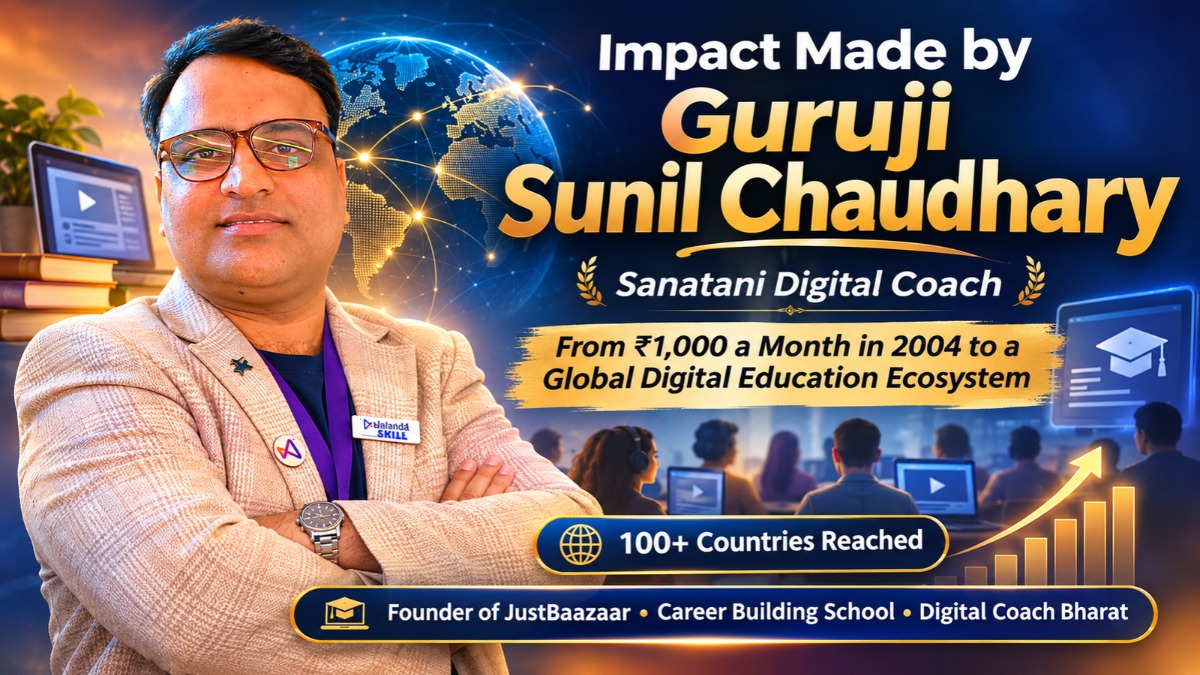
 Launch your Graphy