There are no items in your cart
Add More
Add More
| Item Details | Price | ||
|---|---|---|---|
Mon Oct 5, 2026
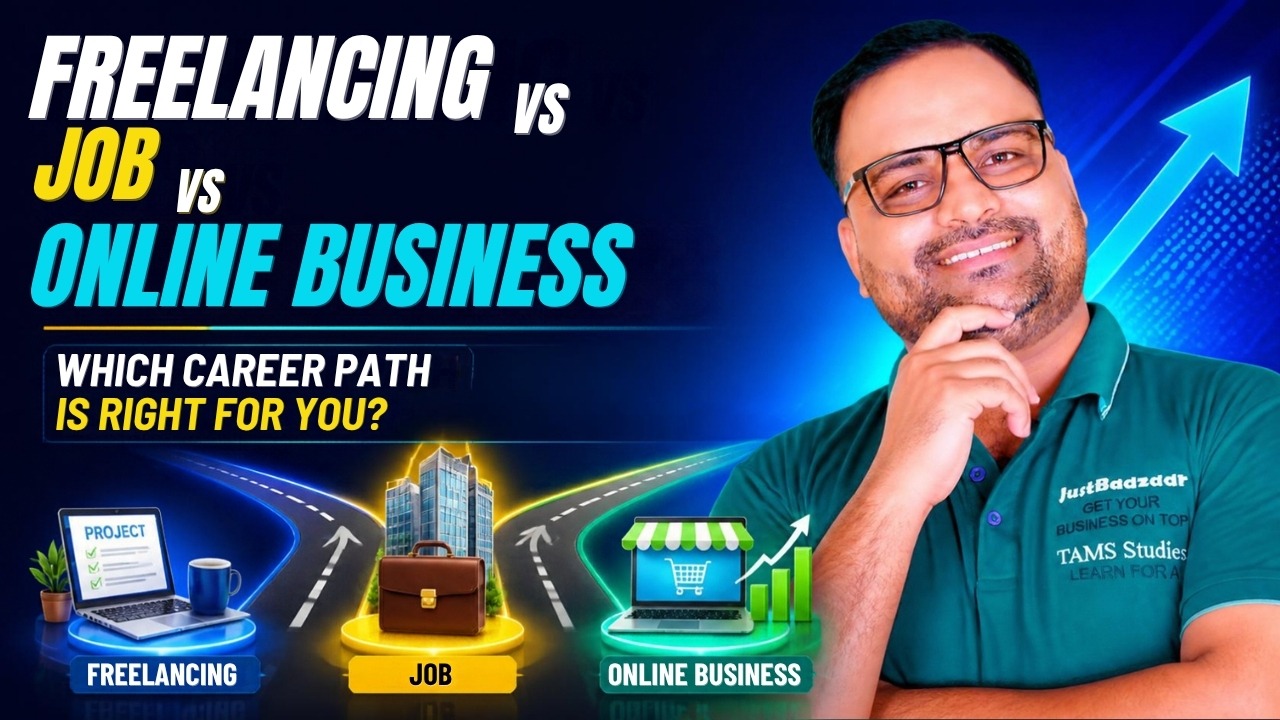
One of the most important career decisions you can make today is not simply choosing what skill to learn. It is deciding how you want to use that skill to build your career.
Should you look for a traditional job?
Should you become a freelancer?
Should you build your own online business?
There is no single correct answer.
I believe the right choice depends on your current skills, financial responsibilities, personality, risk tolerance, experience, and long-term goals.
My simple advice: Do not choose a career path simply because someone on social media says it is the fastest way to make money. Choose a path that matches your present situation and gives you room to grow.
In this guide, I will compare the three paths honestly and practically so that you can make a better decision for yourself.
Before comparing them, let us understand what each model actually means.
In a job, you work for an organization in exchange for a salary or other agreed compensation. Your employer generally defines your role, responsibilities, working structure, targets, and reporting system.
A job can provide structure, professional experience, teamwork, mentorship, and a predictable income arrangement.
For many people, especially at the beginning of their careers, this structure can be extremely valuable.
Freelancing means offering your skills or services independently to clients rather than working permanently for one employer.
A freelancer may work with one client or several clients depending on the nature of the work.
Examples include:
Freelancing gives you more control over the type of work and clients you accept, but it also requires you to find clients, communicate professionally, manage projects, deliver work, and handle your own business development.
An online business goes beyond selling your time directly for a client project.
You may build a service agency, online coaching business, digital product business, education platform, content business, affiliate business, e-commerce brand, or another internet-based business model.
The exact model can vary greatly.
The common idea is that you are building a business system rather than simply performing an individual task for a client.
| Factor | Job | Freelancing | Online Business |
|---|---|---|---|
| Income structure | Usually salary-based | Client/project-based | Business/revenue-based |
| Primary responsibility | Your assigned role | Your clients and projects | Your complete business system |
| Flexibility | Usually lower | Usually higher | Potentially very high |
| Risk | Generally lower at the beginning | Moderate | Can be higher |
| Learning opportunity | Structured | Self-directed and client-driven | Very broad |
| Client acquisition | Usually handled by employer | Your responsibility | Your responsibility |
| Scalability | Usually limited by role | Limited by your available time unless you build a team/system | Potentially scalable |
This table gives you the basic picture, but your real decision requires a deeper understanding.
I would not tell every young person to immediately quit the idea of employment and become an entrepreneur.
That would be irresponsible advice.
A job can be an excellent starting point.
If you are a student, recent graduate, career beginner, or someone who needs stable monthly income, a job may provide an environment where you can learn professional behaviour while developing your technical skills.
A job can teach you things that are difficult to learn from tutorials alone:
These experiences can become extremely useful later if you decide to freelance or start a business.
A job may suit you if:
Freelancing becomes interesting when you have a skill that someone is willing to pay for and you want more independence in how you work.
But let me make one thing very clear.
Freelancing is not simply “working from home.”
It is a professional service business at a smaller scale.
You have to think about your skill, portfolio, positioning, communication, proposals, pricing, deadlines, client relationships, payments, revisions, and reputation.
That is why I encourage aspiring freelancers to focus on becoming genuinely useful rather than simply creating profiles on multiple freelancing websites.
If you want to freelance in SEO, learn SEO properly.
If you want to provide video editing, learn editing properly.
If you want to manage social media, understand content, audience behaviour, analytics, and platform strategy.
Your first objective should be:
“Can I solve a real problem for a client?”
Once the answer becomes yes, you can work on finding clients.
If you want to strengthen your digital foundation, you can also explore CBS resources such as the existing guide on breaking into freelancing with digital skills.
An online business is generally a bigger step because you are not only selling your personal time or expertise. You are trying to build a repeatable system.
For example, imagine you are a freelancer providing social media management.
You manage five clients personally.
As your client list grows, your available time becomes a limitation.
To build a larger business, you may eventually need systems, processes, technology, team members, better positioning, sales processes, and standardized delivery.
That is the difference between simply having work and building a business.
An online business may involve:
It can be exciting, but it also requires greater responsibility.
No.
This is one of the biggest misunderstandings I see when people discuss career paths.
Your career can evolve.
You might start with a job.
Then develop a digital skill.
Then start freelancing part-time.
Then build a small agency.
Later, you may develop digital products or create an online education business.
There is no rule saying that your professional identity must remain unchanged forever.
Think of your career as a journey, not a permanent label.
If you are completely confused about where to begin, I recommend thinking in stages.
First, identify one valuable skill.
Do not try to learn everything at once.
Digital marketing, SEO, content creation, website development, video editing, design, data analysis, sales, and other digital skills can all become useful depending on your goals.
Your first target should be competence, not perfection.
Once you learn the basics, practice.
Create sample projects.
Build your own website.
Optimize a sample page.
Create social media content.
Analyse a campaign.
Write an article.
The purpose is to convert theoretical knowledge into practical ability.
A certificate can show that you completed learning.
A portfolio can show what you can actually do.
Create a small collection of work that demonstrates your capabilities.
For example:
The exact number is not important. The quality and relevance are.
At this point, you can begin applying for jobs, approaching potential clients, or testing a small business idea.
Notice the sequence:
Learn → Practice → Build Proof → Enter the Market.
This approach is much stronger than simply saying, “I want to earn online.”
This is where many beginners make poor decisions.
They see a video promising quick income and immediately buy a course, start an untested business, or leave a stable source of income without preparation.
I recommend a more practical approach.
If you have financial responsibilities, first protect your basic stability.
Then develop a valuable skill alongside your existing work if possible.
Once your skill improves, test freelancing or another business model gradually.
You do not have to make a dramatic decision on day one.
Small experiments can teach you a lot before major commitments.
If you are a student or recent graduate, this is actually a very useful stage for experimentation.
You have an opportunity to build skills before many long-term responsibilities arrive.
My suggestion is to combine three things:
Do not wait until graduation to start thinking about employability.
Your degree and practical skills can complement each other.
Many people say, “I want freedom,” and immediately think freelancing or entrepreneurship is the answer.
But freedom without discipline can create another kind of problem.
When you work independently, nobody may be standing beside you reminding you to learn, contact clients, finish projects, create content, or improve your systems.
You have to become responsible for yourself.
So ask yourself:
If the answer is gradually becoming yes, independent work may become a good fit for you.
Technology changes quickly.
Platforms change.
Search engines change.
AI tools evolve.
Consumer behaviour changes.
Marketing strategies that work today may need adjustment tomorrow.
That is why I don't want you to become dependent on one particular tool or trend.
Instead, build the ability to learn, test, measure, and adapt.
For example, learning SEO is valuable. But understanding how search behaviour works is even more valuable.
Learning one AI tool is useful. But understanding how to use AI to improve your workflow is more transferable.
Learning one social platform is useful. But understanding content, audience, positioning, and communication gives you a stronger foundation.
If you are still confused, answer these seven questions honestly.
Your answers will give you clues.
If stability is your highest priority: explore employment.
If independence is your priority and you already have a useful skill: explore freelancing.
If you want to build systems, products, teams, or a scalable brand: explore online business.
If you are unsure: start with learning and practical experience before making a major decision.
Do not choose a career because someone shows a screenshot of earnings online.
Income depends on skills, market demand, experience, positioning, consistency, business model, geography, and many other factors.
SEO, YouTube, affiliate marketing, trading, dropshipping, freelancing, blogging, AI, e-commerce and ten other things at the same time can create confusion.
Choose one direction first.
A technically strong person who cannot communicate clearly can struggle in both employment and freelancing.
Learn to write emails, explain ideas, ask questions, negotiate professionally, and present your work.
Watching hundreds of tutorials does not automatically make you skilled.
Build something.
Test something.
Make mistakes.
Improve.
Career building is a process.
Give yourself enough time to develop competence and credibility.
This is where I see an important opportunity for modern learners.
Digital skills are not limited to freelancers or entrepreneurs.
They can strengthen a traditional career too.
For example, someone working in sales who understands digital lead generation may become more valuable to an organization.
A marketing professional who understands SEO, analytics, content, and AI can bring broader capabilities to a team.
A business owner who understands digital marketing can reduce dependence on outside agencies and make better strategic decisions.
This is why I encourage people to think about skill ownership.
Your job title may change.
Your company may change.
Your business model may change.
But the skills you develop can continue travelling with you.
You can also read the CBS guide on mastering SEO strategies if SEO is one of the skills you want to explore.
If this article has made you think seriously about your career direction, don't stop at reading.
Use the next 90 days intentionally.
After 90 days, you will have more information about yourself than you had on day one.
You will know what you enjoy, what you are good at, what the market responds to, and where you need improvement.
Let me give you the honest answer:
There is no universally best career path.
A job can be the right choice for one person.
Freelancing can be the right choice for another.
Online business can be the right choice for someone else.
And for many people, the best answer may be a combination that evolves over time.
Do not compare your chapter one with someone else's chapter ten.
Instead, ask yourself:
“What is the smartest next step for me right now?”
That question is much more useful than asking, “Which model will make me rich fastest?”
I believe career building starts with clarity.
You don't need to have your entire life figured out today.
You need to identify your next meaningful step.
If you need experience, get experience.
If you need skills, learn skills.
If you need stability, build stability.
If you want independence, gradually develop the capabilities required for independence.
And if you want to build an online business, first understand the skills, systems, customers, and responsibilities involved.
The internet has created many new possibilities, but possibilities become opportunities only when we combine them with skills, action, patience, and consistency.
That is the mindset I want every learner at Career Building School to develop.
If you are still deciding which direction to take, start by developing practical digital skills and understanding how they can support your career, freelancing journey, or business.
Explore Career Building School and continue your learning journey with practical digital education.
Explore Career Building SchoolNeither is automatically better. A job may suit someone who values structure and predictable income, while freelancing may suit someone who wants more independence and already has a marketable skill.
Yes, freelancing can be a career option for beginners, but it is important to develop a useful skill, build practical proof of your ability, learn client communication, and understand how to find and retain clients.
Every business involves some level of uncertainty. The level of risk depends on the business model, investment, market, planning, and execution. Beginners should validate ideas carefully rather than making large investments immediately.
Depending on your employment contract, local laws, and employer policies, it may be possible. Always check your employment terms and avoid conflicts of interest before taking outside work.
Digital skills can be useful for students because they can complement formal education and provide opportunities to build practical projects, portfolios, internships, freelance experience, and stronger professional profiles.
There is no universal answer. Consider your interests, strengths, career goals, and market demand. Choose one skill you can realistically practice consistently instead of trying to master many skills simultaneously.
Yes. A freelancer can gradually move toward an agency, consulting practice, productized service, education business, or another business model by developing systems, processes, positioning, and a team where appropriate.
A degree can be valuable for many careers, but freelance clients often evaluate the relevance of your skills, portfolio, communication, reliability, and ability to solve their specific problems. Requirements vary by client and profession.
For many beginners, a gradual approach can reduce risk: learn a useful skill, practice it, build proof, test the market, and make larger commitments only after you understand what works for you.
Remember: You don't have to choose your entire future today. Choose your next step wisely, develop valuable skills, and keep moving forward.
 Launch your Graphy