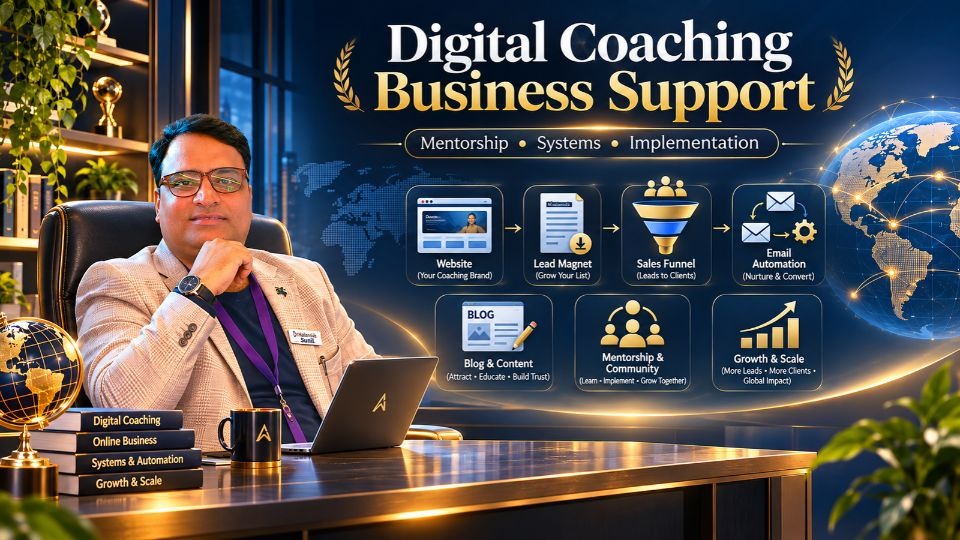
Digital Coaching Business Support With Personal Expert Handholding
Tue Nov 17, 2026
Where Aspiring Digital Coaches Can Get Support in India | Sunil Chaudhary
THE COMPLETE DIGITAL COACH SUPPORT GUIDE • INDIA
When Aspiring Digital Coaches Face Problems, Where Can They Get Support?
A practical, people-first guide to getting clarity, personal handholding, website and funnel help, automation support, accountability, and real Digital Coaching Business Implementation.
By Sunil ChaudharyUpdated 17 November 2026Digital Coach IndiaPractical implementation guide
Quick Answer — Where Can Aspiring Digital Coaches Get Support?
Short answer: Aspiring digital coaches can get support from experienced mentors, structured coaching communities, specialist service providers, implementation programs, peer groups, and credible educational resources. The best choice depends on the specific problem: positioning, offer design, a website, lead generation, sales funnels, automation, content, or accountability. In India, Digital Coach Bharat and Career Building School provide resources and program pathways centered on building a digital coaching business.
That answer sounds simple, but choosing support wisely requires more thought. You need to know what is actually broken before deciding what to buy. A coach with a clear offer but no functional funnel needs a different kind of help from someone who has built a funnel but has no idea whom to serve. This guide helps you diagnose your stage, find the appropriate kind of assistance, evaluate support promises, and make genuine business progress.
Important distinction: Mentoring, learning resources, group support, done-with-you implementation, and done-for-you services are different. Always confirm the current program scope, availability, deliverables, fees, and support boundaries before enrolling.
Why Capable Aspiring Digital Coaches Get Stuck
You can be excellent at what you teach and still struggle to turn that expertise into a viable business. A language tutor may know how to improve fluency. A career counsellor may have helped hundreds of students. A consultant may understand business processes at a deep level. Yet none of that automatically teaches the person how to design an online offer, attract suitable enquiries, organise a digital customer journey, or deliver an effective coaching experience at scale.
In a traditional professional setting, much of the surrounding infrastructure is already available. There may be an employer, classroom, receptionist, billing process, marketing team, or established referral network. When you become an independent digital coach, you take responsibility for designing the system yourself. That is a substantial transition.
Expertise and entrepreneurship are not identical skills
Being able to help somebody is the foundation. Building a reliable coaching business requires several connected capabilities: understanding a market, positioning an offer, communicating value, generating qualified leads, converting enquiries ethically, delivering the promised service, collecting feedback, and managing business operations. If one connection is missing, the whole experience can feel unpredictable.
Information overload can hide a lack of execution
Many aspiring coaches move from one webinar to another. They save templates, purchase courses, explore AI tools, try another website builder, and spend weeks comparing platforms. Activity feels like progress, but the actual business assets remain unfinished. Ask a more useful question: What have I completed this week that a real prospective client can see, use, or respond to?
Isolation makes small obstacles expensive
A DNS error can absorb an afternoon. Unclear sales copy can stop a landing page launch. An unfinished email sequence can leave new subscribers without direction. The problem is not always lack of determination; sometimes the coach lacks a useful feedback loop. Personal guidance, a responsive community, or targeted technical assistance can help remove those bottlenecks.
Getting support is not an admission of weakness. It is a practical business decision. The aim is not to become dependent on another person forever. The aim is to make better decisions, finish essential systems, and learn enough to manage the business responsibly.
Start With a Diagnosis, Not Another Course
Before searching for the best digital coach mentor in India, write down your current position honestly. You may discover that you do not need a new course at all. You may need a review of the offer you already created, a clearer audience definition, a working booking process, or simply a realistic weekly schedule.
If you say...
Likely bottleneck
Support worth seeking
“I know a lot but cannot choose a niche.”
Positioning
Audience and offer clarity session
“People watch me but do not enquire.”
Message or call to action
Content-to-offer review
“I have an offer but no website.”
Digital infrastructure
Website and landing-page implementation
“I get leads but lose track of them.”
Follow-up system
CRM and consent-based email automation
“I have many tools but none connect.”
Integration
Funnel and technical setup support
“I work hard but never finish.”
Consistency
Accountability and milestone reviews
“Clients join but results are inconsistent.”
Delivery design
Program structure and client feedback review
Use this table as a starting point, not a diagnosis carved in stone. For example, low lead volume may result from weak positioning, poor distribution, an unconvincing offer, or an audience that is not ready to buy. A responsible mentor will ask questions and review evidence before prescribing a solution.
Problem One — I Do Not Know My Niche or Ideal Client
A broad identity such as “I help everyone live a better life” makes a new coaching business difficult to explain. It does not tell a potential customer whether the coach understands the problem in front of them. Narrow positioning makes the first conversation more useful. Instead of trying to serve everybody, identify a particular audience, an urgent problem, and a realistic result your expertise can support.
Consider a professional with years of recruitment experience. Instead of advertising generic career coaching, that person might begin by helping first-time managers prepare for interviews and career transitions. A communication trainer might help small-business founders deliver clearer sales presentations. A teacher might support parents who want a consistent home-study routine for a particular age group.
A practical positioning sentence
Complete this statement: I help [specific audience] achieve [meaningful outcome] through [credible process], without [common obstacle]. Do not copy a fashionable niche simply because somebody claims it is profitable. Ask whether you understand the audience, can deliver the outcome ethically, and have evidence of demand.
Interview five to ten people who resemble your ideal client. Ask what they are trying to achieve, what they have already tried, what makes the problem costly, and what practical support would help. Listen for repeated language and genuine purchasing behavior, not just compliments.
If you are beginning from zero, explore the {a('starting','Career Building School guide to starting an online coaching business')} and the {a('about','Digital Coach Bharat founder story and mission')}. Both provide relevant context for converting experience into an intentional coaching direction.
Problem Two — I Lack Confidence and Credibility
Many aspiring coaches believe they must own a luxury office, speak flawless English, or have thousands of followers before offering useful guidance. Those things are not reliable indicators of coaching quality. What matters more is whether you understand a specific problem, communicate honestly, respect your professional limits, and can help a suitable client make progress.
Confidence is not something you wait to receive. It develops when your actions produce evidence. Build a sample worksheet. Conduct a small pilot workshop. Explain a concept clearly on video. Help an appropriate test client with transparent expectations. Gather specific feedback and improve your framework.
Be careful with testimonials. Use genuine reviews with permission, do not manufacture outcomes, and never imply that one client's result is typical for everybody. If you do not yet have client results, describe your process, relevant professional experience, and what the potential client can realistically expect.
Build an evidence-based authority page
Your website should answer: Who are you? Who do you help? Why are you qualified to help? What is your method? What is included? What is outside scope? How can somebody contact you? A clear, modest professional profile is often more persuasive than exaggerated claims of being the “number one” expert.
Mentorship can help you sharpen that positioning. For additional perspective on evaluating mentors, read {a('handholding','the Career Building School comparison of digital coaches and handholding support')}.
Problem Three — I Cannot Turn My Knowledge Into a Sellable Offer
Knowledge becomes a commercial offer when a potential client can understand the problem addressed, the process provided, and what they will receive. “Unlimited transformation coaching” may sound impressive, but it is vague. A defined eight-week communication coaching engagement with initial assessment, practice sessions, feedback, and progress review is much easier to evaluate.
The five elements of a useful coaching offer
Audience: Who is the offer designed for, and who should not buy it?
Outcome: What useful change is the program designed to support?
Process: How will sessions, assignments, templates, and reviews work?
Boundaries: How much access, support, and response time are included?
Price: What does the fee cover, and what costs or renewal terms apply?
Keep the first version manageable. You do not need to create a library of twenty courses before talking to a customer. Start with one defined problem and one offer that you can deliver competently. A pilot program can reveal what participants actually need and which parts of the proposed curriculum are unnecessary.
Visit {a('package','How to Package and Sell Your Coaching Programs Online')} for a related explanation of turning expertise into an offer. Treat sales as a process of helping someone make an informed decision, not as a battle to pressure them into purchasing.
Problem Four — My Website Is Missing, Incomplete, or Unconvincing
A website should function as a clear introduction and decision-support tool. For a new coach, it does not need to be complicated. It does need to work on a phone, explain the offer quickly, establish reasonable credibility, and provide an obvious next step. A polished site with confusing copy is not necessarily better than a simple page with a useful message.
Essential pages for a coaching website
Begin with a homepage, a focused service or program page, an about page, a contact or booking option, and appropriate privacy and terms information. Add a blog when you can consistently publish content that answers genuine audience questions. Ensure forms work, buttons lead to the right destination, and messages reach the correct inbox.
Technical details matter. The domain should connect correctly. The site should use HTTPS, readable typography, compressed images, meaningful headings, descriptive image alt text, and responsive layouts. Avoid excessive scripts that make visitors wait. Test the actual customer journey from a mobile device rather than relying only on a desktop preview.
If you want implementation help, identify which part you can own and which part requires a specialist. You might write your core message while a service provider builds the site. Ask who owns the domain, who has administrator access, what changes are included, and what happens after launch.
This is where a targeted {a('funnel','Digital Coach Funnel Implementation Challenge')} or a suitable done-for-you website service may be more useful than buying another general marketing course.
Problem Five — I Am Not Getting Enough Qualified Leads
“I need more followers” and “I need more qualified enquiries” are not the same goal. Followers may enjoy your content without needing your coaching. A smaller audience with an immediate, relevant problem may be a better foundation for a service business. Before trying to increase traffic, confirm that your message attracts the right people.
Create content around decisions, not only inspiration
Answer questions that prospects ask before hiring someone: What does the process involve? How long should improvement take? What should a beginner prepare? Which mistakes can they avoid? Who is this service suitable for? What alternative approaches exist? Useful content gives people enough information to decide whether to engage.
Choose channels according to where your audience actually spends time and how they seek help. Search-oriented articles can work for specific questions. YouTube videos can demonstrate explanation skills and personality. LinkedIn may be useful for some professional and B2B niches. Local discovery may matter for geographically focused coaching. Not every coach needs to be active everywhere.
Measure more than views. Track how many people visit the offer page, request a resource, book a call, attend a session, and become suitable clients. Collect this data with appropriate consent and privacy safeguards. Improve the weakest relevant step before adding more marketing channels.
For related reading, see {a('leads','How to Attract More Students to Your Online Courses')} on Career Building School.
Problem Six — I Have No Lead Magnet or Clear First Step
A lead magnet is a free, useful resource offered to someone who wants help with a particular problem. It should be specific enough that the right audience understands its value immediately. A “Complete Guide to Life and Success” is broad. A “15-Minute Interview Preparation Checklist for First-Time Managers” makes a clearer promise.
Useful formats include a checklist, short workbook, self-assessment, planning template, quick-start guide, or a focused mini-lesson. Choose the format that is simplest for the user. If your resource takes hours to complete and never produces an immediate useful step, people may download it and forget it.
Lead magnet quality checklist
It addresses one meaningful problem in your coaching niche.
It produces a small, useful outcome without requiring a purchase.
It gives correct information and states relevant limitations.
It is readable and easy to use on mobile.
Its signup form clearly explains any marketing communications.
It connects naturally to the paid offer without withholding essential safety information.
Do not measure success only in downloads. Check whether your subscribers are the right audience and whether they find the resource helpful. A lead magnet is a bridge to trust, not a trick for collecting contact details.
Problem Seven — My Sales Funnel, Landing Page, and Thank-You Page Are Not Ready
A coaching funnel is simply an organised path from first interest to the next appropriate action. It does not have to be manipulative or over-engineered. A typical beginner flow is: helpful content → focused landing page → resource signup → thank-you page → welcome email → optional discovery conversation or program information.
What a good landing page needs
A clear headline says what is offered and for whom. A short explanation describes the benefit. A preview or outline clarifies the resource. A simple form requests only what is necessary. The privacy language is understandable. The call to action is visible. The page should feel trustworthy and work comfortably on a smartphone.
What the thank-you page should do
Confirm that the requested action was completed. Explain when and how the resource will arrive. Offer one helpful next step, such as watching a relevant educational video or learning about a discovery session. Do not overwhelm visitors with unrelated offers. Test every step after connecting the form and email platform.
If your funnel is partly built, get a technical audit rather than immediately rebuilding everything. Check form submission, email delivery, broken links, mobile layout, consent, tracking, and booking functionality. The {a('funnel','Digital Coach Funnel Implementation Challenge')} is especially relevant to this stage because its published description centers on a basic lead capture and follow-up system.
Problem Eight — Email Automation and Integrations Feel Overwhelming
Automation should reduce repetitive work and improve the customer experience. It should not turn your business into an impersonal sequence of messages. A modest system might welcome a new subscriber, provide the promised resource, share two or three relevant educational emails, and invite the person to learn about a suitable service.
Begin with a simple map. Where does a visitor enter the system? Which tool stores the contact? What happens immediately after signup? Which event causes an email to send? How can the person unsubscribe? How will you know if an integration failed?
Common technical mistakes
The form is connected to the wrong list or no list.
The lead magnet download link is missing or broken.
Automated messages contain generic placeholders.
Domain email authentication has not been configured properly.
Sales and support messages go to different inboxes without a clear owner.
No one tests the complete journey as a first-time subscriber.
Use test contacts, check delivery, and document important settings. Your DNS records, domain registrar, email sender, automation platform, and payment tools should have a clear administrator. Ask any implementation provider to provide account ownership details and a handover checklist.
The right mentor will not insist that you buy every fashionable tool. They will help you choose a stack that matches your stage, budget, skills, and actual business processes.
Problem Nine — I Create Content but Cannot Build Trust or Convert Interest
Content becomes useful when it answers a real question and leads naturally to a next step. Random motivational posts may earn reactions, but a coaching business also needs evidence of understanding and a clear explanation of its work. Aim for a healthy mix of education, practical demonstration, client questions, thoughtful perspectives, and transparent descriptions of your services.
Build content from conversations with potential clients. If five people ask how to choose a coaching niche, write an article about niche selection. If viewers repeatedly ask why email automation matters, record a practical walkthrough. If prospects misunderstand the difference between group coaching and personal implementation support, explain the distinctions plainly.
Use an answer-first approach for SEO, AEO, and GEO
For search visibility, create descriptive headings, give direct answers early, and support them with specific examples. Explain unfamiliar terms. Link to genuinely relevant resources. Keep claims accurate and updated. These practices can improve usefulness for readers and help search systems interpret the page, although no technique guarantees ranking or inclusion in AI-generated answers.
Do not publish dozens of repetitive AI-written pages simply to target slightly different keywords. Original examples, real experience, responsible editing, and genuine answers are stronger foundations for long-term credibility. For your video and article strategy, {a('youtube','Digital Coach Bharat on YouTube')} is another place to explore relevant discussions and examples.
Problem Ten — I Am Uncomfortable With Sales, Pricing, and Follow-Up
Many caring coaches worry that selling will make them sound pushy. The solution is not to avoid sales entirely. It is to make the buying process clear and respectful. If somebody has a problem you can genuinely help solve, explaining your offer is useful. Pressuring an unsuitable person is not.
During a discovery conversation, ask about the prospect's current situation, goals, past attempts, constraints, and readiness. Explain your process and the support level available. Discuss fees and payment terms plainly. Be ready to say that your offer is not a good fit when appropriate.
Pricing should reflect the scope, time commitment, delivery cost, experience required, and market fit. Avoid inventing a high “regular price” only to display a dramatic discount. If you offer a promotion, disclose the applicable terms and any ongoing software or implementation costs.
Follow-up can be professional without being intrusive. Send helpful information with consent, answer genuine questions, and make it easy to decline. A prospect who says “not now” should not be trapped in endless messages.
Read {a('webinar','Webinars vs Workshops — Which One Works Best for You')} if you are deciding how to present your expertise through live sessions.
Problem Eleven — I Keep Starting but Never Finish
Motivation fluctuates, especially when a new coach is also managing a job, family, and financial responsibilities. A sustainable system must work on ordinary days, not only when you feel inspired. Replace vague targets such as “work on my business” with specific deliverables such as “publish the program page by Friday” or “test the signup email on Wednesday.”
A practical weekly implementation rhythm
Monday: Choose the most valuable business deliverable for the week.
Tuesday and Wednesday: Build it with minimal distraction.
Thursday: Ask for feedback or attend an appropriate support session.
Friday: Test, publish, or improve the deliverable.
Weekend: Review progress and decide the next priority.
You do not have to use these exact days. The important part is a repeatable cycle of plan, build, review, and ship. A coach with four available hours per week can still make progress with a realistic schedule and clear priorities. Avoid copying someone else's productivity system if it is impossible for you to sustain.
Accountability helps most when it is specific. A good support environment asks what was completed, what is blocked, what was learned, and what happens next. Merely attending another motivational call does not automatically build your business.
Where Can Aspiring Digital Coaches Actually Get Support?
Support is not one product. There are several formats, each appropriate for a different combination of time, skill, budget, and complexity. Understanding these models can save you from buying help you do not need or expecting personal attention from a program that only provides self-paced materials.
Support model
Best suited for
What to verify
Free guides and videos
Exploring options and learning basic concepts
Accuracy, relevance, updates, source credibility
Self-paced structured program
Independent learners with a clear learning schedule
Curriculum, access period, actual support level
Community or group mentoring
People needing accountability and regular feedback
Session schedule, questions policy, moderation
Do-with-me implementation
Coaches who want to build with guided personal help
Number of sessions, review rights, responsibilities
Done-for-you implementation
People with clear direction but limited technical capacity
There is no universal winner. Someone who enjoys building technology may choose a structured course and occasional feedback. Someone with a demanding profession may prefer to delegate website and funnel work, provided they remain involved in clarifying the offer and approving content. Someone at the very beginning should often validate the audience and offer before paying for a large technical build.
How Digital Coach Bharat Can Help You Find Direction
Digital Coach Bharat presents a Bharat-focused introduction to becoming a digital coach, emphasizing purposeful use of experience, personal branding, trust, and a real coaching journey. Its About page explains Sunil Chaudhary's background and the platform's focus on helping people translate knowledge and experience into a structured digital opportunity.
For a beginner, this is a useful starting point because the challenge is often identity: “Can what I know actually help somebody?” The first step is to explore whether your expertise is useful, what audience it may serve, and what business model fits your circumstances.
The practical takeaway is to write a one-page business concept: your audience, problem, first offer, preferred delivery method, and next experiment. Seek feedback on that concept before paying for complex technical systems.
How Career Building School Fits Into the Support Journey
Career Building School provides digital education and coaching-business resources covering important skills such as content, visibility, marketing, and business building. For an aspiring coach, the main advantage of a structured learning environment is the ability to follow a sequence instead of randomly collecting unrelated tools.
A beginner may start by exploring the Digital Coach Foundation program information. A coach struggling to connect landing pages, lead capture, and follow-up can review the Digital Coach Funnel Implementation Challenge. Someone seeking a broader business-building pathway may review Digital Sudarshan, whose public description highlights positioning, offer design, digital presence, lead generation, and implementation systems.
These are different entry points, not interchangeable promises. A program listing can describe a course or support pathway without guaranteeing that every reader will receive the same individual service. Check whether your selected option includes direct mentoring, live sessions, done-with-you implementation, done-for-you delivery, or only learning resources.
Enrollment and pricing notice: Program pricing, availability, access arrangements, and scope can change. One current Career Building School membership page states that new enrolments are not being taken. Refer to each official page and contact the provider for the latest applicable terms rather than relying on an old screenshot or promotional post.
Personal support is most useful when a meaningful decision or implementation barrier remains unresolved despite independent effort. Suppose you have attended a course, selected a niche, created your first offer, and attempted to build a funnel. The pages exist, but the message is unclear and the follow-up emails do not work. An experienced person reviewing the actual pages and customer journey can be more useful than another broad lecture.
What valuable handholding looks like
It begins with understanding your current situation, not immediately recommending a package. The mentor helps prioritise actions, reviews real work, identifies assumptions, and establishes a next milestone. The coach remains responsible for decisions and client promises. Meetings produce tangible next steps: revised positioning, approved copy, a tested workflow, a published page, or a clearer delivery plan.
Support quality should be assessed by what is included: review frequency, response channels, turnaround expectations, scope of feedback, access period, and escalation for complex technical issues. “Lifetime support” and “unlimited support” can mean different things across programs, so request written definitions.
For readers comparing options, {a('handholding','this guide to digital coaches offering handholding')} gives useful questions to ask before joining. If you want to discuss your particular business stage, contact the team through the WhatsApp link in this article.
When to Choose Done-for-You Implementation Instead of Learning Everything
There is a limit to how much technical knowledge every coach needs to acquire. A business coach with a strong offer does not necessarily need to become a developer, conversion copywriter, email deliverability specialist, and analytics engineer. Delegating a clearly scoped project can make sense when you value your time, have budget, and can provide timely inputs.
However, delegation works only when the business owner participates in strategic decisions. No implementation team can responsibly invent your expertise, write truthful client stories without evidence, or guarantee demand. You still need to supply your target audience, service details, brand preferences, approvals, and information about legal or professional restrictions.
Ask for a written implementation scope
Exactly which pages, forms, and emails will be created?
Does the project include domain setup, hosting, email authentication, and integrations?
Are copywriting, blog articles, design assets, or revisions included?
Who pays for third-party software, hosting, plugins, and advertising?
Who owns the files, website, domain, accounts, lists, and created materials?
What testing and handover documentation will be provided?
What support continues after the project is delivered?
Do not treat technical setup as a guarantee of customers. The system makes it easier for suitable people to discover and evaluate your offer; real demand, useful expertise, credible marketing, and responsible delivery still determine whether the business grows.
Watch Practical Digital Coaching Discussions
Learning is most useful when it helps you take the next action. These four video resources are provided as additional viewing options from the links associated with Digital Coach Bharat content. Open a video that relates to your current concern, take notes, and identify one practical task to complete. The precise video titles and topics should be checked on YouTube before describing them as a specific lesson.
These embeds load only when you click Play, which helps avoid the initial weight of four simultaneous YouTube players. If a video owner has disabled embedding, use the YouTube link beneath the player.
How to Choose a Support Provider Without Regret
A polished sales page does not tell you everything about a support provider. Before paying, look for relevant experience, clearly explained services, authentic references, transparent communication, and realistic expectations. Ask to see examples of the kinds of systems being discussed, while respecting client confidentiality.
Ten questions to ask before enrolling
What specific problem will this support help me solve first?
What is the exact list of deliverables or sessions?
Who will personally review my work?
What are the usual response times and support hours?
What work am I responsible for completing myself?
Which third-party costs are not included?
How are revisions, cancellations, and refunds handled?
Who owns my domain, data, accounts, and content?
What happens if the selected technology changes?
How will we measure implementation progress?
Be cautious about promises of effortless income, guaranteed client acquisition, instant authority, or lifelong one-to-one access without written terms. A serious mentor should be comfortable explaining limitations. Compare total value, not only promotional price. The cheapest offer can be expensive if it leaves critical gaps; the most expensive offer may be unnecessary for an early-stage coach.
Start with a small commitment when appropriate. A strategy review or limited technical project can reveal whether the working relationship is productive before you commit to a larger engagement.
A 90-Day Implementation Roadmap for Aspiring Coaches
A useful roadmap creates direction without pretending that every person can reach the same milestone on the same date. The following 90-day sequence is an example, not a promise of income or guaranteed launch. Adjust the pace for your existing experience, available hours, and the complexity of your offer.
01–30
Clarify and Validate
Identify one audience and problem, interview potential clients, write a positioning statement, define a manageable offer, and create a first useful content asset. Ask for feedback before building an elaborate website.
31–60
Build the Minimum System
Publish a simple professional page, create a lead magnet if useful, connect a consent-based signup form, write essential follow-up emails, and confirm the booking or enquiry process works on mobile.
61–90
Test and Improve
Publish targeted content, speak with suitable prospects, review enquiries, improve unclear messages, test the customer journey, and refine delivery materials. Document what worked and which assumptions need another test.
Every week, record three things: one completed asset, one useful learning, and one next action. A published program page is an asset. An interview revealing that your offer language confuses potential clients is useful learning. Editing the headline and testing it is the next action.
If you need support during the roadmap, purchase help for the actual bottleneck. Do not automatically add another platform, automation, or course just because a marketing video makes it sound essential.
How Much Support Does a New Digital Coach Really Need?
There is no universally correct support budget. One beginner may learn to create a service page independently using affordable tools. Another may need specialist assistance because their existing profession leaves little time for technical tasks. The sensible budget is based on financial capacity, the stakes of the project, and whether the support addresses a validated business requirement.
Separate one-time implementation costs from recurring subscriptions. A landing page may involve a design fee, domain cost, platform plan, business email subscription, and optional automation service. A done-for-you provider may include some components and exclude others. The only reliable comparison is a written breakdown of costs and responsibilities.
Do not borrow money you cannot responsibly repay based on an unverified income projection. Avoid making non-refundable commitments before reading terms. If you are still exploring your niche, a free guide, small pilot, or lower-cost feedback session may be better than a full technical implementation project.
As your offer and demand become clearer, you can invest more confidently in the systems that reduce friction and improve service quality. Sustainable growth comes from thoughtful decisions rather than buying the largest package first.
Three Realistic Scenarios — Matching the Problem to the Support
Scenario A — The experienced teacher with no digital audience
A teacher has excellent subject knowledge, but no clear online audience. The sensible first step is to choose a specific learner group, test a small workshop, and collect feedback. Personal positioning help or a starter resource may be appropriate. An elaborate funnel is probably premature.
Scenario B — The consultant with an offer and a broken funnel
A consultant already has an established service and receives referrals, but online enquiries disappear because the form is not linked to an email list. Here, targeted technical implementation, a form test, a short welcome sequence, and clearer booking steps may solve the immediate problem. Relearning all of digital marketing would be inefficient.
Scenario C — The coach with tools but no consistency
A coach has several courses, a website builder, a social media calendar, and a draft webinar. Almost nothing is finished. The main issue may be priorities and accountability. A structured weekly implementation rhythm with milestone review can create movement without purchasing more software.
These are illustrative scenarios, not testimonials or promises. They demonstrate why problem-first support is better than assuming every aspiring coach needs the same package.
Frequently Asked Questions About Digital Coaching Support
Where can aspiring digital coaches get support in India?
They can seek structured learning, expert mentorship, accountability groups, specialist freelancers, done-with-you implementation programs, or done-for-you providers. Digital Coach Bharat and Career Building School are two relevant resources to explore, with current scope and availability to be confirmed on their official pages.
What should I do first if I want to become a digital coach?
Identify a specific audience, a problem you can competently address, and a realistic way to help. Speak with potential clients before investing heavily in technology. Then define your initial offer and a small test of demand.
Do I need a website before finding my first client?
Not always. A clear, honest offer and a professional way to contact you may be enough for initial validation. A website becomes more valuable as you formalise your brand, publish resources, and build a repeatable enquiry process.
What is the difference between mentoring and done-for-you services?
Mentoring provides guidance and feedback while you do much of the work. Done-for-you services implement agreed deliverables on your behalf. Do-with-you support combines your participation with guided execution. The exact scope must be confirmed in writing.
Can AI build my complete coaching business?
AI can assist with planning, drafting, research, content outlines, and some technical workflows. It cannot validate your expertise, guarantee demand, replace responsible client care, or remove the need to review accuracy and protect personal information.
How do I get support with landing pages and email automation?
Start by mapping the intended customer journey. Then choose a structured implementation resource or specialist who can build, test, and document the landing page, form, consent process, email sequence, domain connections, and handover details.
What if I have no leads or paying clients?
Review your audience, offer, channel, message, credibility, and calls to action before increasing spend. Conduct customer conversations and test practical educational content. Paid promotion cannot reliably repair a fundamentally unclear offer.
Is personal handholding necessary for every digital coach?
No. Independent learners may progress through credible free and self-paced materials. Handholding becomes more useful when decisions are complex, implementation repeatedly stalls, or detailed feedback would save meaningful effort.
How long does it take to build a digital coaching business?
There is no universal timeline. It depends on your expertise, market understanding, offer, available time, business systems, and audience response. A 90-day plan can organise work, but cannot guarantee revenue or profitability.
How can I check whether a coaching support program is trustworthy?
Review the written scope, who delivers support, session frequency, examples, ownership, pricing, refund policy, communication expectations, and independent evidence where available. Be cautious of guaranteed income claims.
Can Career Building School help with my digital coaching business?
Career Building School lists resources and programs covering skills and digital coaching systems. Explore the official course pages, compare your present needs with their stated scope, and verify current enrollment and support conditions.
How can I contact Sunil Chaudhary for implementation support?
Use the WhatsApp call-to-action on this page to share your business stage and main bottleneck. Explain whether you need niche clarity, website work, a lead magnet, a funnel, email automation, content systems, or accountability.
Your Next Step — Move From Confusion to Implementation
If you are an aspiring digital coach facing problems, the most valuable next step is not necessarily another lesson. It may be a specific conversation, a clear business decision, a practical review, or a finished system. Begin by naming the actual obstacle. Then choose the smallest credible form of support capable of solving it.
You do not need to become a technical expert in every platform. You do need to understand what your business promises, whom it serves, how clients find you, and whether the delivery experience lives up to expectations. Build a foundation you can explain and maintain.
At Digital Coach Bharat, the mission is to help people turn useful knowledge into a meaningful digital coaching journey. At Career Building School, the focus includes structured skills, systems, and business-building resources. Explore these platforms, review their current offers, and seek help that fits your stage instead of buying based on excitement alone.
People do not need more information. They need implementation. Your knowledge deserves a business, but that business needs clarity, trust, a working process, and consistent action. Start with one problem, complete one meaningful step, and keep building.
About the author — Sunil Chaudhary
Founder of JustBaazaar and Career Building School. His work focuses on helping coaches, trainers, consultants and experts turn knowledge into structured Digital Coaching Businesses through systems, clarity and implementation support. Read his background and mission.
Editorial note: This article is educational and also introduces support resources associated with the author. Program details are subject to current availability and written terms. No earnings, ranking, client acquisition or business result is guaranteed. General business guidance is not individual legal, financial or regulated professional advice.





 Launch your Graphy