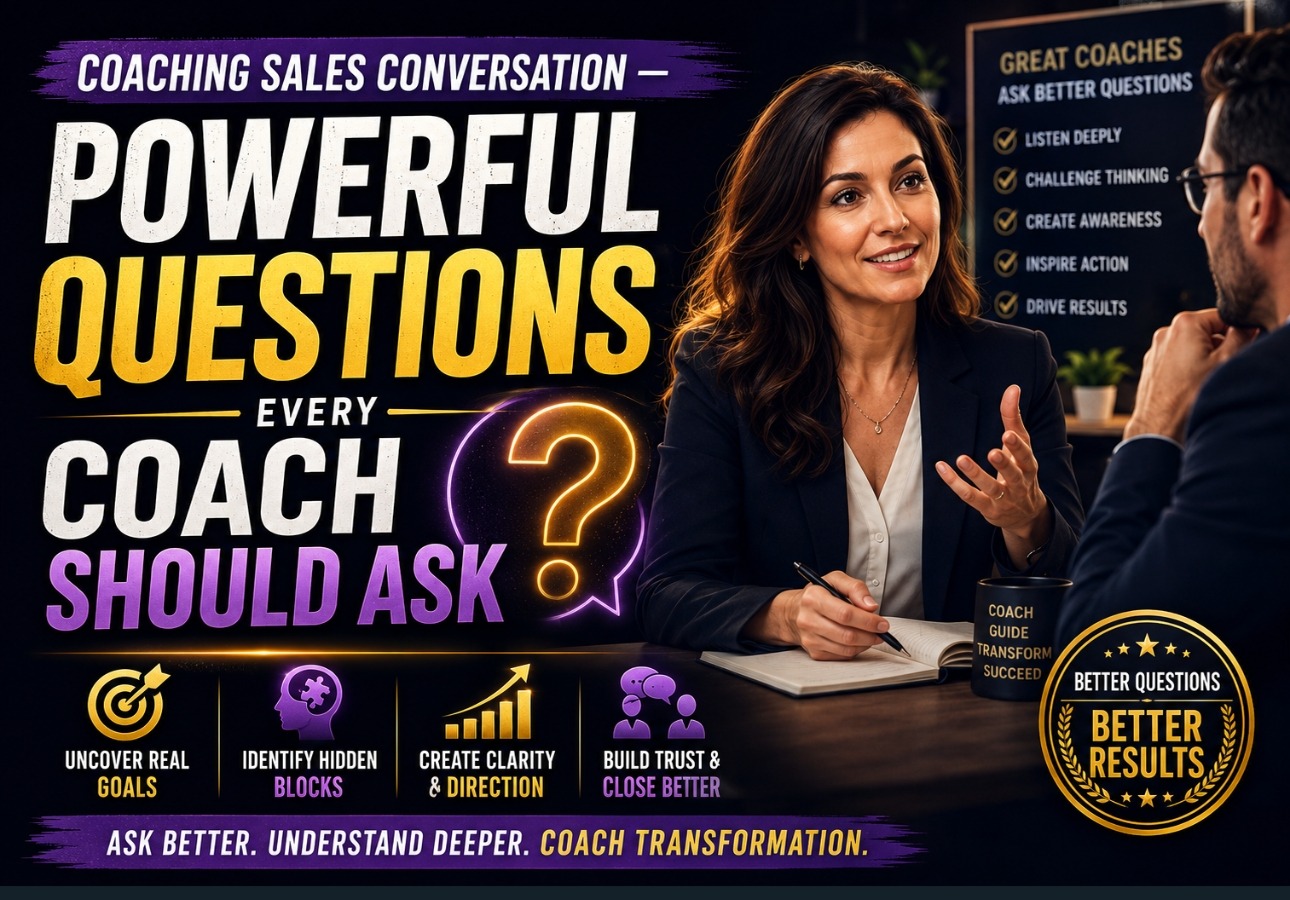
Coaching Sales Conversation — Powerful Questions Every Coach Should Ask
The purpose of these questions is not to pressure someone into buying.
The purpose is to understand:
What they want → what is stopping them → what they are uncertain about → what they actually need → whether they are ready to take action.
1. Vision & Goal Questions
What exactly are you trying to build?
What would you like this to look like 12 months from now?
What is the primary outcome you want—income, impact, freedom, authority, service, or something else?
Who exactly do you want to serve?
What specific problem do you want to help them solve?
2. Current Situation Questions
What have you already built so far?
What have you already tried?
What is working for you right now?
What is not working right now?
What have you learned from your previous attempts?
3. Bottleneck Questions
What do you believe is the biggest thing stopping you from moving forward?
If we removed the technology issue completely, what would still stop you from starting?
If you had the perfect tools and systems tomorrow, would you immediately start taking action?
If not, what would still be missing?
These questions help you discover whether the stated problem is actually the real problem.
4. Research & Comparison Questions
When a prospect is continuously researching, comparing, or asking for more information, don't immediately assume they are wasting time.
Diagnose the pattern.
What are you still trying to become certain about before you move forward?
What information do you believe you are still missing?
If all your current technical questions were answered today, would you be ready to implement?
What exactly are you comparing right now?
What are you hoping to find through this comparison?
What would make you finally say, “This is the right solution for me”?
5. Trust & Mentor Selection Questions
What are the most important factors you consider when choosing a Coach or Mentor?
What would you need to see or understand before feeling comfortable working with someone?
What kind of support are you actually looking for?
What would make you trust a Coach enough to take action?
What does a successful mentoring relationship look like to you?
These questions reveal whether the prospect needs:
expertise,
accountability,
implementation support,
personal attention,
strategy,
or simply confidence.
6. The Constructive Confrontation Questions
These are especially powerful.
But ask permission before using them.
Start with:
“May I challenge you on something I am observing?”
If they agree, ask:
“Do you think some of these questions are helping you gain clarity, while some may also be delaying your decision?”
“Could continuing to research be making it harder for you to actually start?”
“What do you think you are protecting yourself from by continuing to research?”
“Are you looking for more information, or are you looking for more certainty?”
“How much more information do you realistically need before you are willing to take the first step?”
🔥 These are Coaching Questions, not closing tricks.
7. Simplicity Questions
When a prospect says:
“This seems complicated.”
Don't immediately defend your system.
Ask:
“What specifically feels complicated to you?”
“What would the simplest version of this look like for you?”
“Which parts do you believe are absolutely necessary to start?”
“Which parts do you believe can wait until later?”
“If we started with only the essentials, would you be comfortable moving forward?”
This transforms:
Objection → Conversation → Clarity
8. Commitment Questions
Before recommending a program, understand the person's willingness to implement.
“If you decide to move forward, how much time can you realistically commit each week?”
“What are you personally willing to take responsibility for?”
“Where do you expect your Coach to provide support?”
“Are you looking for information, guidance, accountability, or hands-on implementation support?”
“If we decide this is the right path, are you prepared to actually implement rather than continue researching?”
9. Program-Fit Questions
Don't automatically recommend your highest-priced program.
First determine the required level of support.
“Do you primarily need structured learning and implementation, or deeper personal mentorship?”
“How much personal involvement do you expect from your Mentor?”
“Would you prefer a structured group environment or highly personalized support?”
“What level of guidance do you believe you need right now?”
“What would make a program feel genuinely valuable to you?”
10. Recommendation Questions
Before presenting your offer, make the prospect think about their own requirement.
“Based on everything we've discussed, what do you believe you need right now?”
Then say:
“Let me share what I would recommend based on what you've told me.”
This changes your position from:
Seller → Advisor
11. Pre-Closing Questions
After explaining your recommendation:
“Does this approach solve the problem you originally came to me with?”
“What, if anything, still makes you uncomfortable about moving forward?”
“Is your hesitation mainly about investment, timing, trust, complexity, or whether this is the right solution?”
“What would you need to feel confident about taking the next step?”
12. The Final Decision Question
Finally:
“Based on everything we've discussed, do you feel ready to move forward, or do you feel you still need more time to decide?”
Then stop talking.
Let the prospect think.
Let them answer.
Don't rescue them from the silence.
The 10 Questions I Would Teach Every Coach to Memorize
If your students remember nothing else, teach them these ten:
1.
What exactly are you trying to build?
2.
What is actually stopping you from moving forward?
3.
If we solved the technical problem today, would you start?
4.
What are you still trying to become certain about?
5.
What exactly are you comparing right now?
6.
What would make you confident enough to choose a solution?
7.
Are you looking for more information, or more certainty?
8.
Could some of your questions be helping you postpone the decision?
9.
Based on everything we've discussed, what do you believe you actually need from a Coach?
10.
Do you feel ready to move forward, or do you still need more time to decide?
The Golden Rule for Coaches
Don't answer every question immediately.
Sometimes a prospect asks:
“Which platform should I use?”
Instead of immediately answering:
“Use X.”
Ask:
“What makes the platform your biggest concern right now?”
If they ask:
“Which Coach is better?”
Ask:
“What criteria are you using to decide?”
If they ask:
“Can this be done faster?”
Ask:
“Why is speed particularly important to you right now?”
If they ask:
“Can we simplify this?”
Ask:
“What are you trying to simplify—the business, the technology, the investment, or your own involvement?”
Remember This
A Coach's job is not to answer every question. A Coach's job is to understand why the question is being asked.
Because sometimes the prospect needs information.
Sometimes they need clarity.
Sometimes they need confidence.
Sometimes they need a better strategy.
And sometimes…
they need someone to gently show them that they are using more questions to avoid taking action.
That is where Coaching becomes more powerful than selling.

 Launch your Graphy