There are no items in your cart
Add More
Add More
| Item Details | Price | ||
|---|---|---|---|

Mon Aug 31, 2026
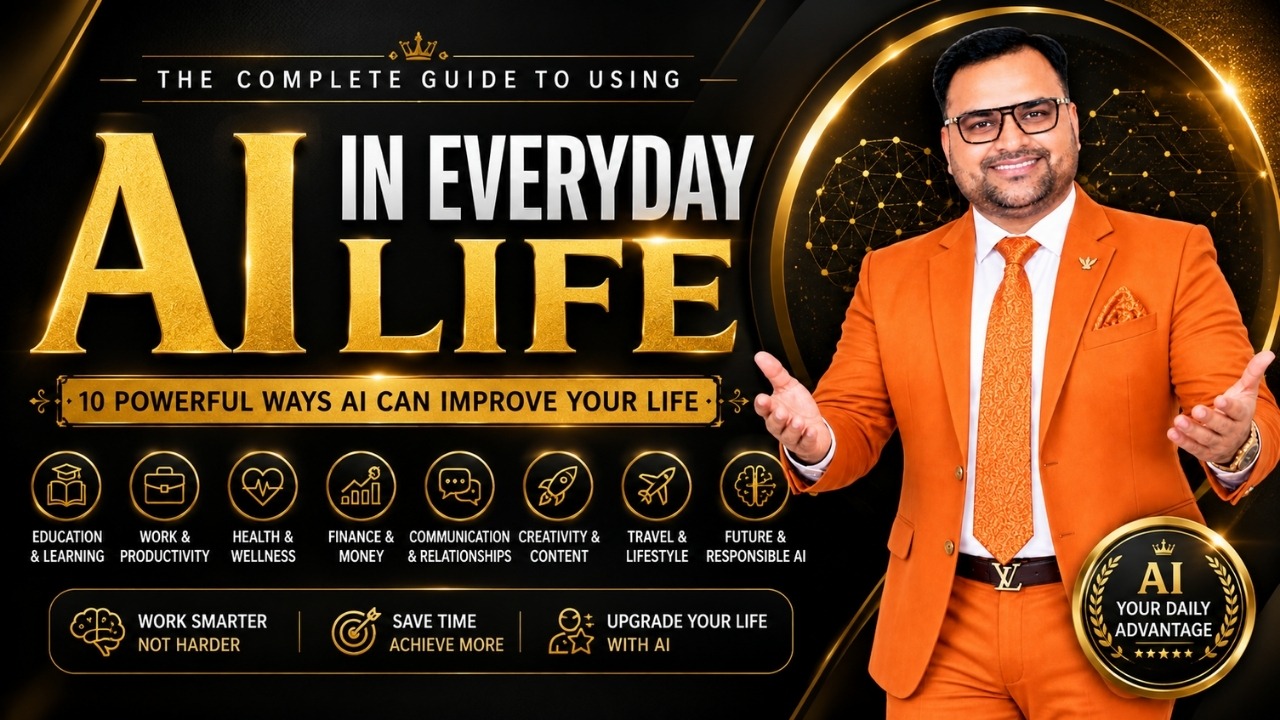
Artificial Intelligence, or AI, is no longer something limited to science-fiction movies, technology companies, or research laboratories. AI is gradually becoming a practical part of our everyday life. From finding information and planning our day to writing messages, learning new skills, organizing tasks, and making better decisions, AI can act as a powerful personal assistant when used thoughtfully.
The interesting thing is that many people are already using AI without realizing how deeply it is becoming integrated into their daily routines. Search engines, recommendation systems, voice assistants, navigation applications, smart devices, translation tools, and modern productivity applications increasingly use Artificial Intelligence to understand our needs and provide personalized assistance.
One of the biggest advantages of AI in daily life is its ability to help us save time, effort, and mental energy. Instead of spending hours searching for information or starting every task from scratch, we can use AI to create a first draft, organize ideas, summarize information, generate options, or help us plan the next step.
AI can help organize your daily tasks, prioritize important activities, create schedules, and turn a long list of responsibilities into a practical action plan.
Instead of searching through multiple sources manually, AI can help explain complex subjects in simple language, summarize information, and help you explore a topic from different perspectives.
AI can assist with emails, messages, social media posts, notes, documents, ideas, and other forms of communication. It can also help improve clarity, grammar, and structure.
AI can help convert a broad goal into smaller and more manageable steps. Whether you want to learn a skill, start a project, or improve your productivity, AI can help create a structured action plan.
AI can become a personalized learning companion by explaining concepts, creating examples, generating practice questions, and adjusting explanations according to your level of understanding.
When you are stuck, AI can help generate ideas, alternatives, questions, outlines, and possibilities. The final judgment, however, should remain with the human.
Imagine having an assistant who is available whenever you need help organizing your thoughts. You could ask AI to create a morning plan, summarize a long document, prepare questions for an important meeting, explain a difficult concept, draft a professional email, or brainstorm ideas for a personal project.
This does not mean that AI should make every decision for us. The real power comes when human intelligence and Artificial Intelligence work together. AI can process information and generate possibilities, while humans bring judgment, experience, values, emotions, creativity, and responsibility.
AI should not be viewed merely as a machine that gives answers. When used intelligently, it can become a powerful tool for thinking, planning, learning, creating, and executing.
While AI can be extremely useful, we should not accept every AI-generated answer without thinking. AI systems can sometimes provide incomplete, inaccurate, outdated, or misleading information. Important decisions should therefore involve human judgment and verification.
The goal is not to allow AI to think for us. The goal is to use AI to help us think better, work faster, learn continuously, and create more value.
The use of AI in daily life is moving from an interesting technology trend to a practical productivity tool. The people who learn to use AI thoughtfully can save time, improve their productivity, and create new possibilities in both personal and professional life.
Education is one of the areas where Artificial Intelligence is creating a major transformation. Students, teachers, professionals, and lifelong learners can use AI to understand difficult concepts, organize information, practice new skills, and create personalized learning experiences.
Traditionally, learning has often followed the same path for everyone. A teacher explains a topic, students study the material, and everyone is expected to progress at roughly the same pace. AI makes it possible to create a more personalized learning experience, where explanations, examples, and practice can be adapted to an individual's needs.
One of the biggest advantages of AI in education is that learners can interact with information in different ways. If a concept is difficult, AI can explain it using simpler language, practical examples, analogies, step-by-step explanations, or questions designed to test understanding.
AI can help learners create study plans based on their goals, current knowledge, available time, and learning requirements.
Students can use AI to ask questions, request explanations, explore examples, and revisit topics that they find difficult.
AI can support language learning through conversation practice, translation, vocabulary exercises, grammar explanations, and writing assistance.
Learners can use AI to create practice questions, quizzes, revision notes, flashcards, and mock tests based on a particular subject.
AI can help learners understand unfamiliar subjects, organize research ideas, summarize complex material, and identify areas that require deeper study.
From digital marketing and coding to communication and business skills, AI can act as an interactive practice partner for continuous learning.
Imagine that you are learning a subject and suddenly get stuck on one concept. Instead of waiting for the next class or searching through dozens of websites, you can ask an AI tool to explain the concept in a way that matches your level.
You could say, “Explain this like I am a beginner,” and then ask for a real-world example. You could request a diagram, ask for a quiz, or ask the AI to identify mistakes in your answer. This creates an interactive learning experience that can continue whenever you need it.
The most powerful educational use of AI is not simply getting an answer. It is using AI to ask better questions, understand concepts deeply, practice skills, receive feedback, and continue learning independently.
AI is not useful only for students. Teachers, trainers, coaches, and educators can also use AI to reduce repetitive work and spend more time focusing on the learning experience.
Educators can use AI to brainstorm lesson ideas, create quizzes, develop examples, prepare learning activities, structure course content, generate discussion questions, and adapt explanations for different levels of learners.
For online educators and knowledge entrepreneurs, AI can also accelerate the process of creating courses, workshops, learning resources, presentations, and educational content.
There is an important principle that students and educators should remember: using AI is not the same as learning.
If a student simply asks AI to complete an assignment and submits the answer without understanding it, the technology may actually reduce the learning experience. However, if the student uses AI to understand the topic, challenge their thinking, practice questions, and improve their work, AI becomes a powerful educational tool.
Human curiosity, critical thinking, creativity, discipline, and judgment remain essential. AI should make learning more accessible and efficient while keeping the learner actively involved in the process.
The use of AI in education can make learning more personalized, interactive, and accessible. Students can learn at their own pace, professionals can develop new skills, and educators can create better learning experiences. The real advantage comes when AI technology and human curiosity work together.
Artificial Intelligence is changing the way businesses are started, managed, marketed, and scaled. From a solo entrepreneur working from home to a growing company with hundreds of employees, AI can help businesses save time, improve productivity, understand customers, create content, and automate repetitive processes.
Earlier, many business activities required separate people, expensive software, or significant amounts of manual work. Today, AI-powered tools can assist entrepreneurs with research, marketing, sales, customer communication, content creation, data analysis, and business planning.
This does not mean that every business should automate everything. The smarter approach is to identify repetitive and time-consuming activities where AI can create genuine value and then combine AI automation with human strategy and judgment.
One of the biggest advantages of AI in business is that it allows entrepreneurs to accomplish more with limited resources. A small business owner can use AI to support activities that previously required multiple specialized skills.
AI can help entrepreneurs research markets, study customer needs, identify trends, compare business ideas, organize information, and discover potential opportunities.
Businesses can use AI to organize customer feedback, identify common questions, understand pain points, and develop clearer customer personas.
AI can assist with marketing ideas, campaign planning, content calendars, advertisements, email campaigns, social media content, and marketing research.
Repetitive activities such as data entry, notifications, content workflows, customer follow-ups, and routine documentation can often be streamlined with AI and automation.
AI-powered systems can help answer common customer questions, organize support requests, provide information, and assist customer service teams.
AI can help businesses analyze large amounts of information, identify patterns, summarize reports, and turn raw data into useful business insights.
Entrepreneurship often requires an individual to perform many different roles. An entrepreneur may need to think about product development in the morning, marketing in the afternoon, sales in the evening, and customer support at night.
AI can act as a versatile digital assistant across many of these activities. It can help brainstorm a business idea, develop a customer profile, create a first version of a landing page, write marketing copy, prepare an email sequence, generate content ideas, and organize a business workflow.
The important point is that AI accelerates execution; it does not eliminate the need for business thinking. An entrepreneur still needs to understand the market, serve customers, create genuine value, make strategic decisions, and take responsibility for the final outcome.
The goal of AI in business is not simply to do more work. The goal is to remove unnecessary manual work so that entrepreneurs can spend more time on strategy, customers, creativity, relationships, and growth.
Lead generation is another area where AI is becoming increasingly useful. Businesses can use AI to understand their target audience, develop lead magnet ideas, create landing page content, generate advertising concepts, prepare follow-up messages, and organize lead nurturing campaigns.
A modern AI-powered lead generation system can connect several stages of the customer journey. For example, a business may attract visitors through content or advertising, provide a useful resource, capture contact information, follow up through email or messaging, and eventually invite qualified prospects to a relevant offer.
This approach is especially useful for coaches, consultants, trainers, experts, freelancers, and knowledge entrepreneurs who want to turn their expertise into a structured digital business.
AI can also support the sales process. It can help sales professionals research prospects, prepare questions, organize customer information, draft follow-up communication, summarize conversations, and identify potential next steps.
However, sales is ultimately about understanding people and solving problems. Technology can support the process, but trust, communication, empathy, credibility, and a strong customer experience remain human responsibilities.
Small businesses may benefit particularly from AI because they often operate with limited time, people, and resources. A business owner can use AI to support multiple functions without immediately building a large team.
For example, a small business could use AI for content planning, customer FAQs, internal documentation, marketing research, proposal drafting, data organization, and repetitive administrative tasks.
The key is to start with one business problem at a time. Instead of adopting dozens of AI tools, identify a repetitive task, measure how much time it consumes, and determine whether AI can perform or assist with that task reliably.
AI-generated content and recommendations should always be reviewed before they are used in important business decisions. AI can produce confident answers that may contain errors, assumptions, or missing context.
Successful businesses will therefore combine Artificial Intelligence, human expertise, critical thinking, and customer understanding. The competitive advantage will not simply belong to businesses that have access to AI, because AI tools are increasingly accessible. It will belong to businesses that know how to apply AI effectively to real problems.
AI is becoming an important business productivity and growth technology. It can help entrepreneurs research markets, create content, generate leads, communicate with customers, analyze information, and automate repetitive work. The biggest opportunity comes from combining AI speed with human strategy, creativity, experience, and judgment.
The modern workplace is changing rapidly, and Artificial Intelligence is becoming an important productivity partner for professionals. Whether you are an employee, manager, freelancer, consultant, entrepreneur, trainer, or business owner, AI can help you complete many routine tasks faster and organize your work more efficiently.
Professional work often involves a large amount of repetitive activity: writing emails, preparing reports, summarizing meetings, researching information, creating presentations, organizing documents, analyzing data, and responding to routine questions. AI can assist with many of these activities, giving professionals more time to focus on work that requires human judgment and expertise.
The real opportunity is not simply working faster. It is learning how to redesign everyday workflows so that AI handles suitable repetitive tasks while humans focus on strategy, creativity, communication, leadership, and decision-making.
AI can support professionals across almost every stage of a typical workday. From the first email in the morning to the final report in the evening, AI can help reduce the time spent on routine work.
AI can help draft professional emails, improve clarity, summarize long messages, adjust tone, and create concise responses to common communication requirements.
Professionals can use AI to organize information, create document structures, summarize research, improve writing, and turn rough notes into polished drafts.
AI-powered tools can help summarize meetings, identify important discussion points, organize action items, and make follow-up easier.
AI can assist with interpreting datasets, identifying patterns, generating summaries, and helping professionals ask better questions about their data.
AI can help professionals brainstorm presentation ideas, organize slide structures, simplify complex information, and develop speaking points.
AI can help professionals explore topics, generate research questions, summarize information, compare ideas, and create starting points for deeper investigation.
Think about the amount of time professionals spend switching between applications, searching for information, writing repetitive documents, and organizing their thoughts. An AI assistant can help bring several of these activities together.
For example, before an important meeting, a professional could use AI to organize background information and prepare questions. After the meeting, AI could help turn notes into action items. Later, it could help structure a report or draft a follow-up email.
The professional remains responsible for reviewing the information and making the final decisions. AI simply reduces the amount of manual effort required to move from information to organized action.
The future of professional productivity is not about making humans work continuously. It is about using technology to remove repetitive work so that humans can spend more time on high-value thinking, creativity, problem solving, leadership, and meaningful work.
Freelancers, consultants, coaches, designers, writers, marketers, developers, and other independent professionals often have to manage both their core work and the business activities surrounding it.
AI can assist with proposals, content ideas, client communication, research, documentation, project planning, marketing, and administrative workflows. This can help an independent professional operate with greater efficiency without immediately increasing the size of their team.
For knowledge professionals, AI can also help transform expertise into different formats such as articles, presentations, educational resources, social media content, email newsletters, and training materials.
Time management is often less about having more hours and more about using available hours intelligently. AI can help professionals break large projects into smaller tasks, prioritize activities, create schedules, and identify potential bottlenecks.
A useful approach is to give AI the outcome you want, the deadline, the resources available, and the constraints you are working under. AI can then help you create a practical starting plan that you can refine according to your experience.
One of the most important principles of using AI at work is simple: never outsource responsibility along with the task.
AI-generated information should be reviewed, especially when it involves financial information, legal matters, confidential business data, technical decisions, or information that could materially affect another person.
Professionals should also understand their organization's policies regarding confidential information and the use of external AI systems. Productivity should never come at the cost of privacy, security, accuracy, or professional ethics.
As AI becomes more accessible, knowing how to work with AI is becoming an important professional skill. The advantage does not come from simply knowing the names of different AI tools. It comes from understanding what problem needs to be solved, what information AI requires, how to evaluate its output, and how to integrate the result into a real workflow.
In other words, AI literacy is becoming a practical part of modern professional literacy.
AI can significantly improve professional productivity by assisting with emails, documents, research, meetings, presentations, data analysis, planning, and repetitive workflows. The strongest professionals will learn to combine AI capability with human expertise, judgment, creativity, and responsibility.
Artificial Intelligence is becoming increasingly useful in health and wellness, helping people organize information, build healthier habits, understand general health concepts, and make better use of digital health tools. From fitness and nutrition to sleep and personal wellness, AI can provide personalized assistance based on the information a person chooses to share.
Modern AI can process large amounts of information and identify patterns much faster than a person can manually. This capability is being used across healthcare, research, fitness technology, health administration, and personal wellness applications.
For individuals, one of the most practical uses of AI is not replacing healthcare professionals, but helping people organize, understand, and act on information more effectively.
AI has applications across many areas of personal wellness. Depending on the tool, it can help with planning, tracking, education, and personalized recommendations.
AI can help create structured workout ideas based on goals, available time, fitness preferences, and equipment. Exercise plans should still be adapted responsibly to individual circumstances.
AI can help organize meal ideas, explain nutritional concepts, create grocery lists, and support better awareness of everyday food choices.
AI-enabled apps and wearable devices can analyze patterns in sleep and activity data and provide insights that may help users understand their routines.
AI can explain general health terminology and concepts in simpler language, helping people prepare questions and understand educational information.
AI can help organize information from compatible health and fitness devices, identify trends, and present personal data in a more understandable format.
AI can assist with routines around movement, relaxation, mindfulness, productivity, and other everyday wellness goals.
One important advantage of AI is personalization. A general wellness article gives everyone the same information, while an AI system can potentially organize suggestions around a person's stated goals, schedule, preferences, and available resources.
For example, someone with a busy schedule may ask an AI assistant to create a simple weekly wellness routine that fits into short periods during the day. Another person may use AI to organize meal ideas around specific preferences or create a practical walking and activity schedule.
The value comes from turning general information into a structured and actionable starting point.
AI can support health education, wellness planning, and personal organization, but it should not be treated as a replacement for a qualified doctor, healthcare professional, or emergency medical service.
Beyond personal wellness, Artificial Intelligence is also being explored and used across professional healthcare environments. Applications include medical research, image analysis, administrative workflows, documentation, drug discovery, patient communication, and decision-support systems.
Healthcare is a particularly important area for responsible AI because errors can have serious consequences. AI systems therefore need appropriate validation, professional oversight, privacy protections, and human accountability.
For patients and families, the most useful approach is to treat AI as an information and preparation tool. It can help someone understand terminology, organize questions, or prepare information for a conversation with a healthcare professional.
Wellness is not only about medical care. Everyday habits such as movement, sleep, nutrition, learning, relaxation, and time management can influence how people experience their daily lives.
AI can help users create routines, track progress, identify patterns, and stay organized. For example, a person may ask AI to convert a broad goal such as “I want to become more active” into smaller weekly actions.
The technology can provide structure, but the actual habit still depends on consistency, personal commitment, and real-world action.
Health-related information can be highly personal. Before using an AI application with sensitive information, users should understand what data is collected, how it is stored, how it may be used, and what privacy controls are available.
It is wise to avoid entering unnecessary sensitive information into AI systems, especially when the purpose of the task can be achieved without sharing those details.
AI can produce useful explanations, but it can also make mistakes. A generated response should never be treated as a confirmed diagnosis or as a substitute for professional medical advice.
If a person has concerning symptoms, an urgent health situation, or a condition that requires professional assessment, the appropriate healthcare professional should remain the primary source of guidance.
AI has the potential to make health and wellness information more accessible and personalized. It can support fitness planning, nutrition organization, health education, personal tracking, and healthy routines. The best approach is to use AI as a supportive technology while keeping professional healthcare, privacy, and human judgment at the center.
Managing money requires awareness, planning, discipline, and good decision-making. Artificial Intelligence is increasingly becoming a useful tool for personal finance, helping people organize expenses, understand financial information, create budgets, analyze spending patterns, and learn more about money management.
Personal finance can become complicated because financial information is often spread across bank statements, bills, subscriptions, investments, loans, insurance, and everyday purchases. AI can help organize large amounts of information and turn it into easier-to-understand summaries.
However, financial decisions can have significant consequences. AI should therefore be treated as a financial education and decision-support tool, not as an unquestionable source of financial advice.
One of the most practical applications of AI in personal finance is helping people understand where their money is going. Once spending information is properly organized, AI can help identify patterns and create useful summaries.
AI can help categorize expenses, summarize spending, identify recurring payments, and make everyday financial activity easier to understand.
AI can help create a practical budget based on income, regular expenses, financial goals, and spending priorities provided by the user.
AI can analyze organized spending information and highlight patterns such as frequently used categories, recurring costs, or changes in monthly expenses.
Whether the goal is saving for education, a major purchase, an emergency fund, or another objective, AI can help turn a broad goal into an organized plan.
AI can explain financial terms and concepts in simple language, helping beginners understand topics such as interest, inflation, diversification, loans, and budgeting.
Entrepreneurs can use AI to organize financial information, analyze business expenses, prepare summaries, and support routine financial administration.
Financial terminology can sometimes feel unnecessarily complicated. Concepts such as compound interest, asset allocation, cash flow, inflation, credit utilization, and investment risk may be difficult for beginners to understand.
AI can explain these concepts at different levels of complexity. A beginner could request a simple explanation, while someone with more experience could ask for a detailed comparison or numerical example.
This makes AI particularly valuable as a financial learning companion. Instead of simply asking what decision to make, a person can ask AI to explain the factors that should be considered before making that decision.
Use AI to understand your money better, organize financial information, explore possibilities, and prepare questions. For significant financial decisions, verify information and consider advice from an appropriately qualified professional.
AI can also assist with investment research by helping users organize publicly available information, understand financial terminology, compare business metrics, summarize reports, and develop research questions.
But there is an important distinction between investment research and investment advice. AI-generated analysis may contain errors, incomplete information, or incorrect assumptions. Financial markets are also uncertain, and past performance does not guarantee future results.
Investors should independently verify important information and consider their own objectives, risk tolerance, time horizon, and financial circumstances before making investment decisions.
Personal finance is only one side of financial management. Business owners can also use AI to support everyday financial workflows.
AI can help organize invoices, summarize expenses, analyze revenue information, structure financial reports, identify unusual patterns, and prepare questions for accountants or financial professionals.
For small businesses, these capabilities can reduce administrative workload and improve financial visibility. However, important accounting, tax, regulatory, and compliance matters should be handled or verified by appropriately qualified professionals.
Many people know that they should save more money, but they do not always know where their money is disappearing. AI can help turn transaction data into categories and summaries that make spending patterns more visible.
For example, after organizing monthly expenses, a person may discover that several small recurring subscriptions or frequent discretionary purchases are consuming a larger amount of money than expected.
The technology does not make the financial decision. It simply helps make the information easier to see and understand.
Financial data is highly sensitive. Before entering bank statements, account information, transaction details, or other private financial information into an AI application, users should understand the platform's privacy, security, and data handling policies.
Never share passwords, PINs, one-time passwords, credit card security codes, or other authentication credentials with an AI assistant. Use only the minimum information required to complete a legitimate task.
As financial technology develops, AI may become increasingly integrated into budgeting applications, banking platforms, financial education, fraud detection, customer support, and personalized financial planning.
The most valuable outcome may be greater financial awareness. When people can understand their income, expenses, goals, and financial choices more clearly, they can make more informed decisions.
AI can make personal finance more organized and understandable by helping with budgeting, expense tracking, spending analysis, financial education, goal planning, and research. The smartest approach is to combine AI-powered insights with verified information, human judgment, privacy awareness, and professional guidance when necessary.
Communication is one of the most important parts of human life. We communicate with family members, friends, colleagues, customers, students, business partners, and people from different cultures every day. Artificial Intelligence is transforming communication by helping people write, translate, understand, organize, and share information more effectively.
From translating a conversation into another language to improving a professional email, AI can reduce communication barriers and make information more accessible. It can also help people communicate their ideas when they know what they want to say but struggle to find the right words.
At the same time, communication is much more than words. Human relationships depend on empathy, trust, emotional connection, shared experiences, and genuine presence. AI can support communication, but it cannot replace the human value of meaningful relationships.
AI can assist with many forms of communication, from everyday messages to complex professional documents. It can help people communicate more clearly, quickly, and confidently.
AI can help draft emails, messages, letters, reports, announcements, and other forms of written communication while allowing the user to select the appropriate tone and style.
AI-powered translation can help people understand and communicate across different languages, making international communication more accessible.
Voice-enabled AI can help users interact with digital systems through spoken commands, questions, reminders, and other conversational interactions.
AI can support accessibility through speech recognition, text-to-speech, transcription, translation, and other technologies that make information easier to access.
Professionals can use AI to improve business emails, proposals, presentations, customer responses, reports, and other workplace communication.
AI can help creators and businesses develop social media ideas, captions, content plans, responses, and communication strategies.
Sometimes the biggest communication challenge is not knowing what to say, but knowing how to say it. A message may be technically correct but sound too formal, too casual, too long, or emotionally unclear.
AI can help rewrite a message for a specific situation. For example, a person might ask AI to make a message more professional, simpler, warmer, shorter, or easier to understand.
This can be especially useful for people who communicate with customers, teams, or international audiences on a regular basis.
Let AI help you improve your words, but keep your intent, values, empathy, and authentic voice human. The best communication combines technological assistance with genuine human connection.
The internet has connected people across countries and cultures. However, language differences can still create significant communication barriers.
AI-powered translation and language tools can help people communicate across languages, understand unfamiliar expressions, and create multilingual content.
This can be particularly valuable for businesses, educators, travelers, creators, researchers, and professionals who work with international audiences.
Businesses communicate with customers through websites, email, messaging platforms, social media, support systems, and sales conversations. AI can help businesses manage some of these communication workflows more efficiently.
AI-powered systems can answer frequently asked questions, organize customer requests, generate draft responses, and help support teams find relevant information faster.
However, customers do not simply want answers. They want to feel understood. Human support remains especially important when a customer has a complex, emotional, sensitive, or unusual problem.
AI can help with practical aspects of personal communication. It can help someone write a birthday message, organize travel plans with family, translate a message, or find better ways to express an idea.
But relationships cannot be automated completely. A perfectly written message does not replace a genuine conversation. A generated birthday wish does not replace remembering someone. A digital assistant cannot replace the experience of spending meaningful time with another person.
Technology should therefore be used to strengthen human connection, not to eliminate the human effort that makes relationships meaningful.
One of the most meaningful applications of AI in communication is accessibility. Speech recognition, automatic transcription, text-to-speech, translation, and intelligent interfaces can help people interact with information in ways that better suit their individual needs.
As these technologies improve, digital communication can become more inclusive for people who face language, hearing, vision, literacy, or other communication barriers.
AI-generated communication should always be reviewed before sending, particularly when the message is personal, sensitive, professional, or legally important.
AI may misunderstand context, emotions, cultural nuances, or the relationship between the people involved. A message that sounds perfect grammatically may still be inappropriate for the situation.
Before sending an AI-assisted message, ask yourself one simple question: “Does this actually sound like me?”
AI is making communication faster, more accessible, and easier across languages and professional environments. It can help with writing, translation, customer support, accessibility, and social media. But the most valuable elements of communication — empathy, trust, authenticity, emotional connection, and human presence — remain deeply human.
Creativity has always been one of the most powerful expressions of human intelligence. Today, Artificial Intelligence is giving creators new ways to generate ideas, develop content, experiment with different formats, and bring concepts to life faster.
Writers, designers, video creators, marketers, educators, entrepreneurs, coaches, photographers, musicians, and content creators can use AI as a creative assistant. Instead of starting every project from a blank page, creators can use AI to explore possibilities, create drafts, organize ideas, and experiment with different approaches.
The most important shift is that AI does not have to replace human creativity. Instead, it can increase the speed at which a person can move from an idea to an experiment, from an experiment to a creation, and from a creation to a finished piece of content.
Content creation involves much more than writing. A single piece of content may require research, ideation, scripting, writing, design, editing, publishing, and promotion. AI can assist with many of these stages.
AI can generate content ideas, headlines, topics, questions, angles, hooks, outlines, and creative directions to help creators overcome the blank-page problem.
AI can help create first drafts for articles, newsletters, scripts, captions, product descriptions, educational material, and other forms of written content.
Generative AI can help creators develop visual concepts, illustrations, graphics, creative compositions, and other visual assets from descriptions and ideas.
AI can assist with video scripts, storyboards, captions, editing workflows, content repurposing, and other parts of the video production process.
AI technologies can assist with transcription, audio editing, voice-based applications, podcast workflows, and converting spoken content into other formats.
Creators and businesses can use AI to develop content calendars, captions, hooks, post ideas, short-form scripts, and platform-specific content variations.
One of the most powerful applications of AI in content creation is content repurposing. A creator may have one long-form article, video, webinar, podcast, or presentation and turn its key ideas into multiple content formats.
For example, a long educational video could become a blog article, several short videos, social media posts, an email newsletter, a carousel, frequently asked questions, and discussion topics.
AI can help organize and adapt the core ideas for different formats while the creator maintains control over the message, accuracy, personality, and final presentation.
Don't ask AI to replace your creativity. Ask it to multiply your creativity. Your experience, perspective, stories, opinions, and original ideas provide the human foundation; AI can help you develop and distribute them faster.
Writers and bloggers can use AI at almost every stage of the content development process. It can help with keyword research ideas, article structures, headlines, introductions, outlines, FAQs, editing, readability, and content repurposing.
However, publishing large quantities of generic AI-generated content is not a sustainable content strategy. Search engines and audiences ultimately benefit from content that demonstrates real expertise, originality, usefulness, and genuine value.
A stronger approach is to use AI for research assistance and production efficiency while adding personal experience, original examples, expert insights, and human editorial judgment.
Personal branding requires consistent communication. Experts, coaches, consultants, founders, and creators often have valuable knowledge but struggle to publish consistently because content production takes time.
AI can help turn expertise into a structured content system. A single idea can be developed into educational posts, videos, articles, emails, FAQs, lead magnets, and other assets.
This allows a personal brand to maintain a more consistent presence while the creator focuses on the most important element: developing and communicating valuable expertise.
Digital marketers can use AI to support audience research, campaign planning, advertising concepts, landing page copy, email marketing, social media content, customer segmentation, and performance analysis.
AI can also help marketers test multiple creative ideas quickly. Instead of spending days creating one version of a campaign, a marketer can develop several concepts, evaluate them, and refine the strongest direction.
The final marketing strategy should still be based on real customer data, business objectives, brand positioning, and measurable results.
Creativity often improves when people can experiment without excessive cost or time. AI lowers the effort required to test an idea.
A creator can explore different headlines, visual concepts, storytelling approaches, scripts, or content structures before deciding which direction deserves further development.
This creates an important advantage: more experiments can lead to better creative decisions.
One of the biggest risks of using AI for content creation is producing content that sounds generic. If every creator uses AI in exactly the same way, much of the resulting content can begin to sound similar.
Your personal stories, experiences, lessons, opinions, examples, cultural context, and unique way of explaining things are what make your content recognizable.
AI should therefore help you express your voice more efficiently rather than erase it.
Creators should verify factual claims, respect intellectual property, disclose synthetic media when appropriate, and avoid presenting AI-generated material as authentic human-created evidence when that distinction matters.
It is also important to understand the terms and policies of the AI tools being used, particularly when working with client information, confidential material, copyrighted assets, or sensitive data.
AI is becoming a powerful creative partner for writers, designers, marketers, educators, entrepreneurs, and content creators. It can accelerate ideation, writing, visual development, video production, repurposing, and publishing. The greatest results come when AI speed is combined with human originality, expertise, creativity, authenticity, and editorial judgment.
Artificial Intelligence is not limited to offices, classrooms, or large technology companies. It is increasingly becoming part of everyday lifestyle experiences. AI can help people plan trips, organize their homes, discover useful information, make smarter purchases, prepare meals, and manage everyday activities.
One of the biggest benefits of AI in lifestyle applications is personalization. Instead of receiving exactly the same recommendations as everyone else, users can provide their preferences, budget, schedule, interests, and requirements and receive suggestions that are more closely aligned with their needs.
Whether you are planning a weekend trip, organizing your home, deciding what to cook, or looking for a new skill to learn, AI can reduce the amount of time spent searching and organizing information.
Travel planning traditionally involves searching across multiple websites for destinations, transportation, accommodation, activities, restaurants, weather, local information, and schedules. AI can help bring many of these planning activities into a more organized workflow.
AI can help create travel itineraries based on destination, duration, interests, budget, preferred activities, and available travel time.
Travelers can ask AI to organize attractions, activities, meals, and travel time into a practical day-by-day itinerary.
AI translation tools can help travelers understand signs, menus, messages, basic conversations, and information in unfamiliar languages.
AI can help travelers explore food options based on preferences, dietary requirements, location, budget, and the type of experience they want.
AI can create customized packing lists, preparation checklists, activity plans, and questions to consider before a trip.
Travelers can use AI to explore destination ideas based on interests such as history, nature, culture, food, adventure, relaxation, or photography.
A useful travel itinerary is rarely the same for two people. A family with children, a solo traveler, a business traveler, and a couple looking for a relaxing holiday may all visit the same destination but require completely different plans.
AI can help personalize an itinerary by considering factors such as available time, interests, budget, transportation preferences, and desired pace.
For example, instead of asking for a generic three-day itinerary, a traveler could provide specific preferences and ask AI to create a schedule that includes reasonable travel time, breaks, activities, meals, and flexibility.
Use AI to build a strong starting plan, but verify important details such as opening hours, transportation schedules, local regulations, weather conditions, reservation requirements, and travel advisories before acting on the information.
Smart homes are another area where Artificial Intelligence is becoming increasingly useful. AI-enabled devices can help automate routines, understand voice commands, manage connected devices, and provide personalized experiences.
Depending on the technology available, AI can assist with lighting, climate control, entertainment, security alerts, energy management, reminders, and other household routines.
The broader idea is simple: instead of manually controlling every connected device, intelligent systems can learn from instructions and routines to make everyday interactions more convenient.
Home management involves many small tasks that can easily become overwhelming. AI can help create cleaning schedules, shopping lists, maintenance checklists, household routines, and organizational plans.
For example, you could provide a list of household responsibilities and ask AI to organize them into daily, weekly, and monthly tasks. You can then modify the plan according to your family's actual routine.
The advantage is not that AI manages the home independently. The advantage is that it can help convert mental clutter into an organized plan.
Meal planning is another everyday activity where AI can be useful. Users can provide ingredients they already have and ask for meal ideas, recipe variations, preparation steps, or a grocery list.
AI can also help organize meal ideas around preferences, available cooking time, or a particular style of cuisine.
However, people with allergies, medical dietary requirements, or other specialized nutrition needs should verify important recommendations with appropriate qualified professionals.
Online shopping provides consumers with an enormous number of choices. AI can help people compare features, organize requirements, understand product specifications, and identify options that may fit their needs.
Instead of asking only, “Which product is best?”, a more useful approach is to define the actual problem: What am I buying, why do I need it, what is my budget, and which features matter most?
AI can then help structure the comparison. The final purchase decision should still consider independent reviews, current pricing, warranty information, return policies, and the reliability of the seller.
AI can become useful whenever there is information to organize or a decision that requires multiple considerations.
It can help create reading lists, weekend plans, learning schedules, personal projects, event checklists, gift ideas, packing lists, household plans, and many other everyday resources.
This is one reason AI is becoming so powerful: its applications are not restricted to one profession. Almost any activity involving information, planning, or repetitive organization can potentially benefit from intelligent assistance.
Greater convenience can be valuable, but people should remain aware of the decisions being made on their behalf. Automated recommendations may reflect incomplete information, commercial incentives, outdated data, or assumptions that do not match the user's actual preferences.
AI should therefore make life easier without making people completely passive. Reviewing important recommendations and making the final choice remains a valuable human responsibility.
AI is becoming a practical lifestyle assistant for travel planning, home organization, meal planning, shopping research, translation, and everyday decision-making. Its greatest value comes from reducing information overload and helping people create personalized plans while keeping human judgment, verification, and personal preferences at the center.
Artificial Intelligence is moving from being a specialized technology used by technology companies to becoming an everyday tool used in education, business, healthcare, communication, creativity, finance, travel, and personal productivity. The future of AI will not simply be about smarter machines; it will be about how intelligently humans choose to use them.
Throughout this article, we have seen how AI can influence different areas of our lives. It can help us learn faster, organize information, automate repetitive work, create content, communicate across languages, plan our finances, improve productivity, and make many everyday activities more convenient.
But technology alone does not determine the outcome. The real advantage comes when people combine AI capabilities with human intelligence, experience, creativity, judgment, ethics, and action.
Earlier generations of technology were often designed for a specific purpose. AI is different because modern AI systems can perform many different kinds of tasks through natural language and other intuitive interfaces.
A single AI assistant can potentially help a student understand a difficult concept, help a professional prepare a presentation, help an entrepreneur brainstorm a business idea, help a creator develop content, and help a family organize a travel plan.
This flexibility is one of the biggest reasons why AI is becoming such an important technology for everyday life.
AI can act as a learning companion by explaining concepts, generating examples, creating practice questions, and adapting explanations to different levels of understanding.
AI can reduce repetitive tasks and help professionals organize information, draft content, analyze data, and improve everyday workflows.
Writers, designers, marketers, educators, and entrepreneurs can use AI to move faster from ideas to drafts, experiments, and finished creations.
Translation, transcription, voice interfaces, and multilingual AI can help people communicate and collaborate across geographical and language barriers.
AI can organize information, identify patterns, compare possibilities, and help people think through complex decisions.
By assisting with planning, research, summarization, organization, and repetitive tasks, AI can help people spend more time on meaningful work.
As AI becomes easier to use, the ability to communicate clearly with AI systems is becoming increasingly valuable. This is often described as prompting or prompt engineering.
A vague instruction may produce a generic result. A clear instruction containing context, objective, audience, constraints, examples, and desired output can produce a much more useful result.
In simple terms, better questions often lead to better AI-assisted outcomes.
Don't focus only on learning AI tools. Learn how to think clearly, ask better questions, provide better context, evaluate answers, and take intelligent action. These skills remain valuable even as individual AI tools change.
There is widespread discussion about whether AI will replace humans. The more useful question is how humans and AI will work together.
AI can process information quickly, generate possibilities, and automate many repetitive tasks. Humans contribute goals, values, emotional understanding, lived experience, accountability, judgment, relationships, and responsibility.
The future is therefore likely to reward people who can combine technological capabilities with uniquely human strengths.
As AI becomes better at producing routine outputs, certain human capabilities can become even more important.
The more powerful AI becomes, the more important responsible use becomes. AI systems can produce incorrect information, misunderstand context, reflect biases in their data, or generate confident-sounding answers that require verification.
Responsible AI users should therefore develop the habit of checking important information before acting on it.
This becomes especially important in areas such as healthcare, finance, legal matters, education, employment, privacy, and other situations where an incorrect answer can have serious consequences.
AI systems can become more useful when they have more context, but users should not automatically share every piece of personal information.
Before using an AI service, consider whether the information you are providing is necessary. Avoid sharing passwords, authentication codes, highly sensitive personal information, confidential business information, or other data unless you understand the security and privacy implications.
Convenience should never come at the cost of careless data sharing.
Just as digital literacy became important with the rise of computers and the internet, AI literacy is likely to become increasingly valuable.
AI literacy does not mean everyone needs to become a programmer or AI researcher. It means understanding what AI can do, what it cannot do, how to use it effectively, how to verify its output, and how to use it responsibly.
Students, professionals, entrepreneurs, educators, parents, creators, and senior citizens can all benefit from developing practical AI skills.
You do not need to transform your entire life overnight. A better approach is to identify repetitive or time-consuming activities and experiment with AI one task at a time.
You might begin by using AI to summarize information, plan your day, learn a new concept, improve a piece of writing, brainstorm ideas, organize a project, or create a checklist.
Once you understand what works, gradually integrate AI into other areas of your personal and professional life.
Artificial Intelligence is not simply another software trend. It represents a major shift in how people interact with information, technology, work, education, and creativity.
The winners of the AI era will not necessarily be the people who know the largest number of AI tools. They will be the people who understand how to combine AI with their knowledge, creativity, experience, judgment, relationships, and ability to execute.
AI can generate an idea, but a human can give that idea purpose. AI can create a draft, but a human can add experience and meaning. AI can analyze information, but a human must decide what matters.
That is why the future of AI is ultimately not just about machines becoming smarter. It is about humans becoming more capable with intelligent technology.
AI has the potential to become one of the most useful technologies in everyday life. From education and healthcare to business, creativity, communication, finance, travel, and personal productivity, its applications are expanding rapidly.
The goal should not be to use AI everywhere simply because it exists. The goal is to identify where AI can create genuine value and use it with intelligence, responsibility, privacy awareness, human judgment, and purpose.
The future is not simply AI versus humans. The real opportunity is humans + AI — combining the speed and capabilities of intelligent technology with the creativity, wisdom, empathy, and purpose of human beings.
 Launch your Graphy