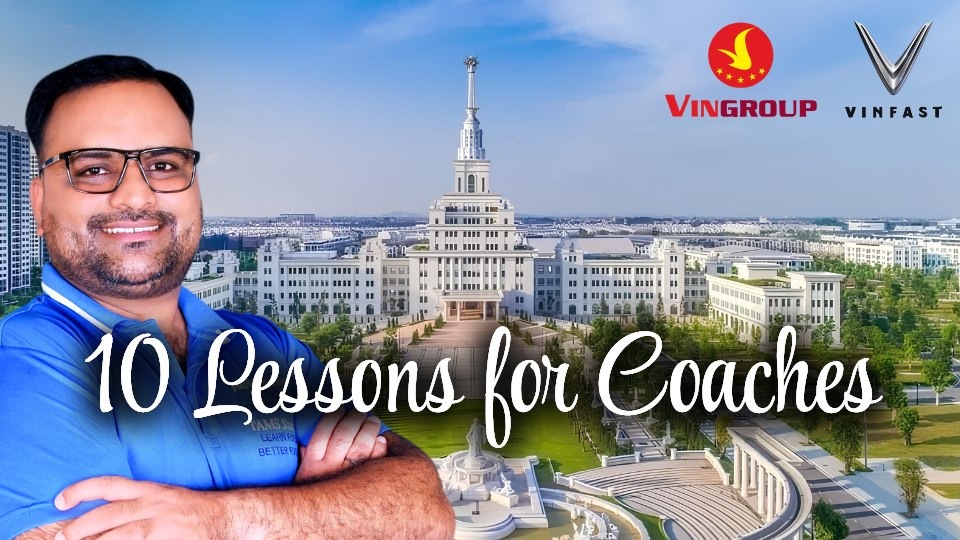
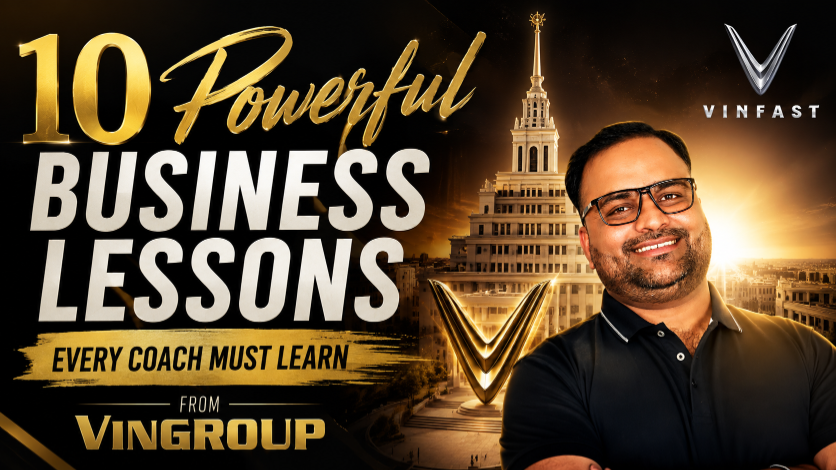
# 10 Powerful Business Lessons Every Coach, Expert, Trainer & Consultant Can Learn from VinGroup
**SEO Title:** 10 Business Lessons for Coaches, Experts & Consultants from VinGroup
**Meta Description:** Discover 10 powerful business lessons for coaches, experts, trainers, and consultants from VinGroup and VinFast’s ecosystem, speed, branding, customer experience, innovation, and global expansion strategy.
**Suggested URL Slug:** `business-lessons-for-coaches-from-vingroup`
**Primary Keyword:** business lessons for coaches
**Secondary Keywords:** coaching business strategy, how to build a coaching business, business lessons from VinGroup, coach business growth, expert business strategy, personal branding for coaches, coaching ecosystem
---
## 10 Business Lessons Every Coach, Expert, Trainer & Consultant Can Learn from VinGroup
What can a coach learn from an electric vehicle company?
Quite a lot.
In fact, the story of **VinGroup and VinFast** offers some fascinating lessons for anyone building a coaching business, consulting business, training business, expert brand, or knowledge-based company.
This is not really a story about cars.
It is a story about **vision, ecosystem building, speed, customer trust, innovation, market expansion, and legacy**.
During a journey through Vietnam, the scale of the VinGroup ecosystem becomes clear. The group operates across areas including residential development, education, mobility, tourism, and electric vehicles. VinFast represents one part of a much larger ecosystem.
And that is where the first major lesson begins.
**The biggest coaching businesses of the future will not simply sell courses. They will build ecosystems.**
---
# What Can Coaches Learn from VinGroup?
Coaches, experts, trainers, and consultants often make the same mistake.
They focus on creating **more content**.
Another course.
Another webinar.
Another PDF.
Another Instagram Reel.
Another certification.
Another workshop.
But business growth does not come simply from producing more information.
The bigger question is:
> **Can you build an ecosystem around the transformation you provide?**
VinGroup's story gives us 10 powerful principles to think about.
---
# 1. Stop Building Courses. Start Building an Ecosystem.
One of the most powerful lessons from VinGroup is the idea of an ecosystem.
The group is not limited to a single product. Its ecosystem includes residential developments, universities, mobility services, electric vehicles, tourism and entertainment.
Think about what that means from a coaching-business perspective.
A coach shouldn't necessarily think:
**"What course should I launch next?"**
A better question is:
**"What complete journey can I create for my audience?"**
For example, a digital business coach could create:
* A free educational resource
* A content platform
* A free community
* A starter workshop
* A flagship coaching program
* A mastermind
* A certification
* A membership
* Done-With-You implementation
* Advanced consulting
Now the business is no longer dependent on one product.
It becomes an ecosystem.
### The punchline:
**Products make money. Ecosystems create businesses that compound.**
A course gives someone information.
An ecosystem gives someone a path.
And that distinction can completely change your business model.
---
# 2. Sell a Mission, Not Just Your Knowledge
When VinFast's leadership was asked why the group entered the automobile sector, the answer focused on a larger purpose: positively impacting people's lives through transportation.
That is a powerful lesson for coaches.
Your audience is rarely looking for information just for the sake of information.
A business owner doesn't really want another marketing lesson.
They want more customers.
A professional doesn't necessarily want another communication course.
They want confidence, influence, and career growth.
A coach's audience doesn't buy knowledge.
**They buy the possibility of transformation.**
Therefore, your positioning should go beyond:
"I teach digital marketing."
"I provide business coaching."
"I conduct leadership training."
Those describe the service.
Your mission explains the **why**.
For example:
**"I help knowledge professionals turn their expertise into scalable digital businesses."**
That sounds very different.
The first statement describes teaching.
The second describes transformation.
### Remember:
**People compare products. People commit to missions.**
---
# 3. Speed Beats Perfection
One of the strongest themes in the VinFast story is speed.
The company highlights its ability to act quickly, including the rapid development of its manufacturing presence in India. The transcript notes that the Tamil Nadu plant came together in 17 months.
Now look at the coaching industry.
Someone spends six months planning a course.
Three months choosing a logo.
Two months designing a website.
Another month deciding what camera to buy.
And then...
Nothing gets launched.
This is where many experts get trapped.
They confuse **preparation with progress**.
You don't need the perfect website.
You need a useful website.
You don't need the perfect video.
You need a helpful video.
You don't need the perfect course.
You need a transformation-focused offer that people can actually use.
### Here's the principle:
**Done and improved beats perfect and invisible.**
Launch.
Learn.
Measure.
Improve.
Repeat.
Speed creates learning.
Learning creates advantage.
---
# 4. Think Global, Even If You Start Local
VinFast's story is also a reminder that a company can begin in one country while building toward a much larger market.
The story specifically highlights its expansion from Vietnam into India, including its presence on roads in Delhi NCR and its manufacturing plans in Tamil Nadu.
The lesson for coaches is simple:
**Don't let geography become a limitation of your imagination.**
A consultant from Aligarh can serve a client in Bengaluru.
A trainer from Delhi can work with someone in Dubai.
A business coach in Mumbai can build an audience across multiple countries.
Digital platforms have changed the equation.
Your physical location may be local.
Your knowledge business doesn't have to be.
So don't build your brand thinking:
**"How do I become the biggest coach in my city?"**
Think:
**"How can I become the most trusted expert for a specific problem, regardless of geography?"**
### One powerful line:
**Your office may have an address. Your expertise doesn't need one.**
---
# 5. Remove Buying Risk Before Asking for the Sale
VinFast's India strategy includes several customer-focused measures discussed in the transcript, including a 10-year battery warranty, free charging on its network through March 2029, free maintenance for three years, and a buyback/value assurance approach.
The deeper lesson isn't about cars.
It is about **risk reversal**.
Every buyer has doubts.
A coaching prospect may wonder:
"Will this work for me?"
"Will I actually implement it?"
"What happens if I get stuck?"
"Will I get support?"
"Is this worth the investment?"
Your job as a coach is not to manipulate those doubts away.
Your job is to **answer them honestly**.
You can reduce uncertainty through:
* Clear deliverables
* Implementation support
* Templates
* Checklists
* Community access
* Accountability
* Case studies
* Demonstrations
* FAQs
* Transparent expectations
* Appropriate guarantees
The better your customer experience, the less energy you need to spend convincing people.
### Remember:
**Every objection is often an unanswered question.**
---
# 6. Build Trust Before You Build Sales
Another important lesson from the VinFast story is the way the broader ecosystem creates credibility.
The story takes viewers through the township, university, manufacturing complex, mobility ecosystem, vehicles, infrastructure and leadership vision before arriving at the larger business proposition.
There is a lesson here for personal brands.
Many coaches make every piece of content a sales pitch.
Every Reel says:
"Join my program."
Every post says:
"Book a call."
Every email says:
"Buy now."
Every live session becomes a launch.
Eventually, the audience becomes tired.
Instead, create a **trust engine**.
Teach.
Explain.
Demonstrate.
Tell stories.
Break down mistakes.
Show case studies.
Answer difficult questions.
Share frameworks.
Give useful insights.
When your content consistently creates value, your audience begins to associate your name with expertise.
And then selling becomes much easier.
### The punchline:
**Trust is the shortest sales funnel.**
---
# 7. Don't Solve One Problem. Solve the Entire Customer Journey.
VinFast's approach wasn't simply about manufacturing vehicles.
The transcript describes an ecosystem involving electric vehicles, charging infrastructure, mobility services and other supporting elements.
That gives coaches another powerful lesson.
Don't stop at information.
Think about what happens **before, during, and after** your coaching program.
For example:
### Before the program
Help people understand the problem.
### During the program
Teach the framework.
### After the program
Help them implement it.
### Advanced stage
Help them scale it.
This creates continuity.
Instead of being:
**"The person who sold me a course."**
You become:
**"The person who helped me transform my business."**
That is a completely different position.
### Information creates awareness.
### Implementation creates transformation.
And transformation is what creates testimonials, referrals, reputation, and long-term authority.
---
# 8. Enter the Market Before Everyone Is Comfortable
One of the most interesting parts of the story is the decision to invest in India's EV ecosystem when the market was still relatively small.
The transcript says the company decided to invest in India in 2023, when EV penetration was still limited, rather than waiting for the market to fully mature. It invested in manufacturing and supporting infrastructure.
This is an important entrepreneurial lesson.
Most people wait for certainty.
Entrepreneurs look for **signals**.
They ask:
Where is the market moving?
What technology is changing behavior?
What problem is becoming bigger?
What audience is emerging?
What capability will become valuable in the next five years?
This is especially relevant for coaches and consultants.
AI.
Automation.
Personal branding.
Creator businesses.
Digital communities.
Knowledge commerce.
Specialized consulting.
These areas are evolving rapidly.
You don't need to blindly jump onto every trend.
But you should learn to recognize structural change early.
### Here's the principle:
**Followers wait for proof. Leaders look for potential.**
---
# 9. Don't Build Customers. Build Believers.
Perhaps one of the most interesting statements in the story comes from the CEO's vision for the next decade.
He says he wants the company to become a household name and be remembered for creating change, caring about society, and helping customers adopt EVs, rather than simply being remembered as a company that sells cars.
That is branding at a deeper level.
A customer buys.
A believer identifies.
This is why strong coaching brands create communities.
Think about what happens when people don't simply say:
"I bought his course."
But instead say:
"I'm part of this community."
"I'm part of this movement."
"I'm building this mission."
That is identity.
And identity is one of the strongest forces in brand building.
### Customers ask:
**"What's in it for me?"**
### Believers ask:
**"How can I be part of this?"**
The goal isn't to manufacture blind loyalty.
The goal is to build something meaningful enough that people genuinely want to participate.
---
# 10. Build a Business That Outlives You
The final and perhaps most important lesson is **legacy**.
The VinFast leadership vision described in the transcript goes beyond selling vehicles. It speaks about future generations, sustainability, green mobility, society, and long-term impact.
This is where coaches need to think differently.
If your entire business depends on you personally taking every call...
If every sale requires your personal presence...
If every class requires you to teach live...
If every client needs direct access to you...
Then you may have created a successful profession.
But you haven't necessarily created a scalable business.
The bigger question is:
**What remains when you step away?**
Your frameworks.
Your intellectual property.
Your community.
Your content library.
Your systems.
Your team.
Your methodology.
Your brand.
Your students.
Your clients' success stories.
That is what creates business value beyond your calendar.
### Revenue is important.
### Impact is important.
### But legacy asks a bigger question:
**What continues because you started?**
---
# The Bigger Lesson for Coaches, Experts, Trainers and Consultants
The VinGroup story is ultimately not a lesson about cars.
It is a lesson about **thinking bigger**.
A company can start with one industry and build an ecosystem around a larger vision.
A coach can start with one skill and build an ecosystem around transformation.
You might begin with SEO.
Then build a digital marketing program.
Then create a community.
Then launch consulting.
Then create certification.
Then build software.
Then develop events.
Then build partnerships.
The possibilities are enormous.
But the foundation remains the same:
**Start with a problem.**
**Build a solution.**
**Create trust.**
**Build an ecosystem.**
**Move quickly.**
**Think beyond geography.**
**Remove customer risk.**
**Create identity.**
**And build for the long term.**
---
# What Is the Most Important Business Lesson for Coaches?
If only one lesson from this entire story is remembered, let it be this:
> **Don't build a coaching business that depends on selling the next course. Build an ecosystem that continuously creates transformation.**
That shift changes everything.
Your content becomes the beginning of a journey.
Your free resources become entry points.
Your community becomes the environment.
Your coaching becomes the transformation mechanism.
Your advanced programs become the next level.
Your brand becomes the trust layer.
And your mission becomes the reason people stay.
That is how a coach moves from being a **content creator** to becoming a **category leader**.
---
# Frequently Asked Questions
## What can coaches learn from VinGroup?
Coaches can learn ecosystem building, mission-driven branding, speed of execution, global thinking, customer risk reduction, trust building, complete customer journeys, early market entry, community building, and long-term legacy thinking from the VinGroup and VinFast story.
## How can a coach build an ecosystem?
Start by mapping the complete customer journey. Create a free entry point, educational content, community, starter offer, flagship program, advanced coaching, implementation support, and appropriate continuity products or services.
## Why should coaches build an ecosystem instead of just selling courses?
A single course creates a transactional relationship. An ecosystem creates a longer customer journey, more opportunities to serve clients, stronger retention, deeper trust, and a clearer path from beginner to advanced transformation.
## How can coaches differentiate themselves in a crowded market?
Don't compete only on information. Build a distinctive point of view, clear mission, recognizable methodology, strong personal brand, valuable content, community, customer experience, and measurable transformation.
## Should coaches wait until their business is perfect before launching?
No. The lesson from the VinFast story highlights the value of speed and execution. Coaches should launch useful solutions, learn from customers, improve continuously, and avoid allowing perfectionism to become an excuse for inaction.
## How important is personal branding for coaches and experts?
Personal branding helps people associate a specific problem, perspective, methodology, and transformation with an identifiable expert. Strong personal brands combine expertise with trust, consistency, positioning, storytelling, and thought leadership.
---
# Final Takeaway
The future belongs to coaches who stop thinking like course creators.
Think like **business builders**.
Think like **ecosystem architects**.
Think like **category creators**.
Because the question is no longer:
**"How many courses can I sell?"**
The better question is:
**"How much transformation can I create, and how powerful an ecosystem can I build around it?"**
That's the shift from **knowledge to business**.
From **expert to authority**.
From **course creator to ecosystem builder**.
And ultimately...
From **income to impact to legacy**.
If you're a coach, expert, trainer, or consultant, don't just build something people can buy.
**Build something people can belong to.**
**Build something people can grow through.**
**Build something that can outlive you.**
That is how knowledge becomes a business.
That is how a business becomes a brand.
And that is how a brand becomes a legacy.
 Launch your Graphy